Showing posts with label Elizabeth Gaskell. Show all posts

Monday, 7 December 2015

Mad about tea! (The Victorians love for a simple cup of tea)

Originally introduced to Britain in the 1650’s from China, Tea was a luxurious drink for the wealthy. But by the eighteenth and nineteenth century an increase in availability meant that it had become much more normal to have tea. Julie Fromer describes that ‘tea had become a commodity of necessity, forming a crucial part of daily patterns of consumption and domesticity’(1) showing that society had taken tea by storm and integrated it into their everyday lives. So much so that the crockery they used became a symbol of class and wealth.

In my blog I will give an insight into the world of tea and tea parties exploring how the types of crockery used and the time of day played a big part in the way Victorians were viewed. For the purpose of this blog I attended the Alice in Wonderland exhibition at the British library and have included some photos of my findings. I also went to the Victoria and Albert museum to research the ceramics and crockery used in Victorian Britain.  
Figure 1. Marigolds: The china closet, knole by Ellen Clacy

China and crockery in general played a big role in showing class within a household. The more delicate and ornate, the more valuable. One way Victorians showed class was to display their crockery, tea trays, and expensive objects for all to see. As depicted in this watercolour by Ellen Clacy housed in the Victoria and Albert museum, It shows a famous china cabinet belonging to Lady Betty Germain at Knole. What is interesting about this watercolour is that is shows the blue china that was very popular in the Victoria era. This type of china is also shown within the book A Victorian household by Shirley Nicholson. Based on the diaries of a Victorian woman an inventory of everything in a house was taken and a specified note was taken about ‘a shelf on brackets, especially designed for the display of blue and white China.’(24) This account clarifies that blue and white china was very fashionable but also was used for display in homes.

Elizabeth Gaskell gives an interesting description of a china cupboard in Mary Barton published in 1848 ‘In the corner between the window and the fireside was a cupboard, apparently full of plates dishes, cups and saucers […] However, it was evident Mrs Barton was proud of her crockery and glass, for she left her cupboard door open, with a glance round of satisfaction and pleasure.’ (15) Gaskell shows how prominent the cabinet was in the household and how much it represented the wealth and class the Barton’s had. Just in this one description you get the hint that by leaving the cupboard doors open Mrs Barton wanted to show the world her collection of crockery.
But on the other hand, Gaskell portrays the working class side of life by showing how the Barton’s only have enough crockery for six people so their guest would have to bring her own cup and saucer.
Figure 2. Plate by Christopher dresser 

One of the major contributors of crockery and ceramic’s in the Victorian era was Minton’s, A large manufacturer. Fig.2 shows a plate, cup and saucer that Minton’s produced it is housed within the Victoria and Albert Museum. This set would have appealed to the middle and upper-class diners and was designed in 1875 by Christopher Dresser, it is made of bone china and would be very delicate. It also is a representation of the fashion at that time by having a Japanese and Chinese style ornament printed and painted as a design. While at the Victoria and Albert Museum I came across many pieces of crockery which all had foreign aspects to them, Foreign designs were another peak of fashion within Victorian Britain and it is even shown in Mary Barton ‘bright green japanned tea-tray, having a couple of scarlet lovers embracing in the middle […] propped up by a crimson tea-caddy, also of japan ware’(15) The Japanese style was very popular in the Victorian time and still is integrated into crockery today. I have a Japanese style blue and white plate at home so the theme is still available in in modern life.
Figure 3. Alice at the Mad Hatters Tea-Party, John Tenniel
In Alice’s Adventures in wonderland by Lewis Carroll published in 1865 you get a different side to the care and pride that is placed upon tea, crockery. At the Mad tea-party Carroll depicts a table set out for many people but the three seated are all crowded in one corner, It is always tea time for the characters and there is ‘no time to wash the things between whiles.’(64) This shows that all of the crockery is on display but most of it is not clean, the table is a mess which wouldn’t comply with the expectation of a normal tea party.
The etiquette at a normal tea party is to always be polite and to be delicate with everything you do. Which is all turned upside down in Alice’s Adventures in Wonderland. The complete disregard for the tea party itself is unsettling, in Victorian England the expectation is to be light handed with the crockery. Whereas the Hatter and the March Hare tried to ‘put the Dormouse into the teapot’ (67) and they upset the milk jug when moving places. The manners and etiquette can both be seen in this interpretation of Alice in wonderland in 1985
The etiquette is exaggerated in this clip but it shows how manners did not matter at the Hatters tea-party. One point where it is shown is whether it is civil to offer wine if you have none. But also sitting down at a table when you haven’t been invited.

Figure 4. Tea cups and saucers at the
British Library
The mad tea-party in Alice’s Adventures in wonderland resonated within culture and within people so much that people have tried to capitalise on profits from the brand. Creating china tea sets and cake stands decorated with the original illustrations by John Tenniel this is shown in fig 5. I found these products when I visited the Alice’s Adventures in wonderland exhibition at the British Library. The original cup and saucer set on display but these sets were found in the gift shop.    
While researching tea I came across a website which told the history of how afternoon tea started. Anna, the 7th Duchess of Bedford complained about having a ‘sinking feeling’ in the late afternoon which in turn made her take tea in her chambers around this time. This grew and eventually she invited guests to join her. Then more and more social people decided to follow the trend and started creating tea parties. The time for tea was very important, before dinner which was usually served at 8 o’clock, afternoon tea had two varieties. A low tea or afternoon tea was served at 4 o’clock for the upper-class people. Whereas a high tea was served at 5 or 6 o’clock in place of dinner for the middle and lower classes. This is the reason it is always tea time at the mad hatters tea party, it is always 6 o’clock.
Figure 5. Afternoon Tea, Alexander Rossi
Tea parties are still going on today and is considered very elegant and formal but it is normally called an Afternoon tea which is held in mid to late afternoon.
Tea is still very widely used within modern society but it doesn’t have the same etiquette and manners required because it is so widely available. People can drink tea in their own homes, but Afternoon tea is normally saved for an occasion and is taken in a country house with scones, jam, cream, finger sandwiches, cakes and a large pot of tea.


Works Cited:
Carroll, Lewis. Alice’s Adventures in Wonderland; And, Through the Looking Glass: And What Alice Found There. Oxford: Oxford UP, 2009. Print
Fromer, Julie E. A necessary luxury: tea in Victorian England. Athens: Ohio UP, 2008. Ebook
Gaskell, Elizabeth. Mary Barton. London: Penguin classics. 2003. Print
Nicholson, Shirley. A Victorian household. Gloucestershire: Sutton Publishing ltd, 2005. Print
Works Cited (images):
Figure 1. Clacy, Ellen L. “Marigolds: The China Closet, Knole”. Victoria and Albert Museum Web. 1880. 1 December 2015 http://collections.vam.ac.uk/item/O17964/marigolds-the-china-closet-knole-watercolour-clacy-ellen-l/
Figure 2. Dresser Christopher. “Plate”. Victoria and Albert Museum. Web. 1875. 1 December 2015 http://collections.vam.ac.uk/item/O80298/plate-dresser-christopher/
Figure 3. Tenniel, John. “Alice at the Mad Hatters Tea Party. Digital image The Victorian web 2007. 6 December 2015 http://www.victorianweb.org/art/illustration/tenniel/alice/7.1.html
Figure 4. Foord, Korie. “Tea cups and saucers at the British Library” 2015 JPEG file
Figure 5. Rossi, Alexander. “Afternoon Tea” web 2015 http://www.afternoontea.co.uk/information/history-of-afternoon-tea/

Dickens and The Victorian Serial


The early Victorian period was the time of great developments and changes in printing technique – the biggest being that of cheaper literature mass-production (10, Wynne). Where novels had previously been a privilege of the higher classes, stories were now becoming increasingly accessible for the growing number of readers in society.  With this development came the trend of serialization, which is “the division of narrative into separately issued instalments” (Sutherland, 87). Not only did this allow the public to continually purchase segments of a story rather than the - more costly - full novel, but it also came with great commercial potential. This was exploited greatly by publishers, who used the surge of newly-literate to maximize their sales, offering cheap literature rather than “work of artistic merit” (Wynne, 11).

                      Nonetheless, the serialization also held value for the readers beyond the financial benefits. Because of the “ability of serial narratives to capture and retain the attention of a wide readership” (12), there was a prominent social aspect to the experience. This showed in what is referred to by scholars as a ‘community of readers’. Since a majority of magazines came out on Saturdays, it became a habitual and communal event to read the new instalment together – perhaps even
The Pickwick Papers (Figure 1)
out loud. As a result, the serial mode of publishing became so popular, that some critics worried for its dangers. They suggested that, because of “each instalment offering so many shocks and thrills” (13), the readers may become addicted to this consumption of literature. Others, however, argued in favour of the serialization, speaking of how it increased the quality of the plots of the novels as every segment needed to contain excitement to keep its following of readers. Regardless of the opinions of the critics, there was no denying the truth: serial fiction was the new literary trend.

                    When speaking of serialization, it is impossible to not mention Charles Dickens. After all, his first novel, The Posthumous Papers of the Pickwick Club (more commonly known as The Pickwick Papers), is considered to be the novel that established this huge trend in Victorian publishing. The Pickwick Papers tell the adventures of a kind and wealthy gentleman, Mr. Samuel Pickwick, who is the founder and president of the Pickwick Club. The story was published in twenty parts, one every month during the years of 1836 and 1837, each instalment sold for one shilling. Because of Dickens’ success with this The Pickwick Papers, he “played an important role in raising the status of serial fiction” (Wynne, 11). This mode of publishing was hardly a new phenomenon, however, but in fact dates back to the seventeenth century. Dickens’ novels, however, spoke to a new audience and, after a slow start of a mere 400 copies per issue, The Pickwick Papers soared up to 40,000 by the forth issue. Dickens followed with Oliver Twist and Nicholas Nickleby and the sales increased with another ten thousand. In the end, he published no less than eight of his novels in this format (Sutherland, 92-93).
All The Year Round (Figure 2)


                   Alongside his writing of serial fiction, Dickens started a career as an editor of the magazine Household Worlds in 1850. It featured stories such as his own novel Hard Times and Elizabeth Gaskell’s North and South. The novels featured social problems and were accompanied with articles dealing with the same issues and themes. In 1859 he left Household Worlds for another periodical; All The Year Round. Its contents were considered somewhere within the “borderline between ‘highbrow’ literary culture” and “’lowbrow’ weekly penny magazines”(Wenny, 22-23), which suited the larger numbers of middle-class readers. But whereas Household Worlds handled serious issues, All The Year Round grew to be all about entertainment and serial fiction. The first novel to be featured was Dickens’ A Tale of Two Cities, shortly followed by Great Expectations in 1860-61. However, while Charles Dickens established his profession as an editor with his two periodicals, he was not, after all, the author of all its serials. Still, there was a clear implication of ownership, especially with “his demand that contributors remain anonymous” (Wenny, 25). This resulted in displeased authors who did not receive proper credit, as well as in misconceptions regarding the source of the work. When discussed in the press, the stories were often spoken of as if Dickens himself had written them. Even though this caused a great debate, Dickens continued to have highly regarded writers in All The Year Round, thus keeping its status and firm position on the market (Wenny, 25-26).

                 Naturally, as with all winning concepts, others were quick to join in to that of serialization. Several famous authors of the time started their careers through serial fiction. The list includes names such as Wilkie Collins, George Eliot, Thomas Hardy, and, as previously mentioned, Elizabeth Gaskell.  With Gaskell, several scholars found her writing unfit for serial fiction. According to them she was “repeatedly unable to provide the proper climactic ending for each weekly instalment” and instead using a more “rambling narrative” (Hughes & Lund, 96). When writing for Charles Dickens’ Household Worlds, Gaskell’s style of writing was a reason for an argument with the editor. Dickens wanted each part to “be self-contained” and have “a clear climax and resolution”, while Gaskell preferred a                     

The Offices of All The Year Round in Wellington Street, London
(Figure 3)
more slow-paced storyline. However, previous to North and South, Gaskell had written a three-part serial, Lizzie Leigh, which held more of the ‘self-contained’ quality that Dickens sought. Although its instalments may not end with dramatic cliff-hangers, they had a more subtle hook. For instance, Gaskell would end a part right before a conversation, leaving the reader intrigued as to what words were to be exchanged between the characters (Hughes & Lund, 97-98). This was at least enough for the editorial eyes of Dickens, who continued to feature her stories. In retrospect, one may wonder if the following - North and South and the argument it sparked - may have had him regret this decision in some respects.

               Two writers, William Makepeace Thackeray and Charles Lever, had a go at the Dickensian way of serialization (twenty parts, one every month). However, both soon found the form of publishing undoable. Not surprising, as releasing a novel in numbers equals an entirely different kind of pressure. If the story wasn’t complete before the release of the first instalment, one had to keep to the writing deadlines for every upcoming release. Furthermore, as with the conflict between writer and editor with Dickens and Gaskell, the plotline of the story had to be formatted to keep the readers interest. If the novel was not written to provide interesting and exciting events in every instalment, it would be very hard for it to survive in the market of serial fiction. 

                But the time for these novelists may have come later, as the number of serials published dwindled in the following decades. In the late 1830’s, at the beginning of the serialization trend, “there were at maximum some 15 part-issued shilling serials a year” (Sutherland, 87). The amount decreased to around five in the 1840’s and to one or two at the end of the 1860’s. Ultimately, and quite suitably, the person to revive the serialization was also the last great Victorian writer to truly stick to this format of publication. Charles Dickens remained faithful to the serial novel until his death in 1870. This is rather curious, since his books would have sold well in any format of publishing. Even though his serial publication paid extremely well, Dickens was one of few privileged writers to have the option of publishing his works however he wanted – this due to his large and faithful Victorian readership. And yet, for reasons unknown, he happily proceeded to publish in numbers for 35 years, until the end of his life and the end of the great time of serialization (Sutherland, 87-88).


Bibliography:

Literature:
Hughes, Linda, K. & Lund, Michael. Victorian Publishing and Mrs. Gaskell’s Work.Virginia: The University Press of Virginia, 1999. Print.
Sutherland, John. Victorian Fiction: Writers, Publishers, Readers. London: Macmillan Press,1995. Print.
Wynne, Deborah. The Sensation Novel and the Victorian Family Magazine. Hampshire: Palgrave, 2001. Print.

Pictures:
Figure 1: http://www.uvic.ca/library/featured/collections/serials/pickwick.php

Figure 2: http://www.theguardian.com/books/2015/jul/13/dickens-marginalia-famous-contributors-journal-wilkie-collins-elizabeth-gaskell

Figure 3:
http://www.theguardian.com/books/2015/jul/13/dickens-marginalia-famous-contributors-journal-wilkie-collins-elizabeth-gaskell

Wednesday, 2 December 2015

What got the Victorians so spooked?

Figure 1. Original London Ghost Walk: 
Tour Leader, Richard Jones
From the first gothic novel The Castle of Otranto (1764) by Horace Walpole to the late nineteenth century ghost story The Turn of the Screw (1898) by Henry James, it’s clear that the Victorians were obsessed with supernatural stories. Despite technological and scientific discoveries, the era saw an overwhelming surge in curiosity towards ghosts and, inevitably, saw an increase in the gothic literature produced. What raised these ghosts from their graves into the literary canon of the nineteenth century? My blog shall delve into the philosophical and psychological depths behind the golden age of ghost stories, discussing why they were (and still are) so alluring and why they were embedded in the foundations of the Victorian gothic texts. Ultimately aiming to answer one question: what got the Victorians so spooked? For the purposes of my blog, I attended the Original London Ghost Walk, led by Richard Jones, to expand my knowledge on local ghosts and supernatural traditions. Throughout my post, I have included thoughts and images obtained from my trip.

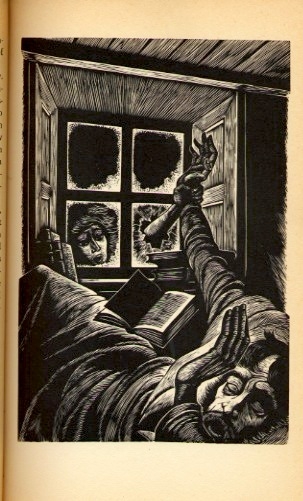
            During the Victorian era, phantoms of young children were exceptionally common in the literary haunting experience. For example, Catherine Linton’s ghost at the start of Emily Bronte’s Wuthering Heights (1847):


[M]y fingers closed on the fingers of a little, ice-cold hand! The intense horror of nightmare came over me […] and a most melancholy voice sobbed, “Let me in – let me in!” […] I discerned, obscurely, a child’s face looking through the window (30).


Figure 2. “Wuthering Heights Illustrations” 
by Fritz Eichenberg
This quotation reveals a connection between Lockwood and the young spectre; a hair-raising physical intimacy as his fingers “closed on” those of Catherine’s. The term “fingers” suggests an image of doubling, the window is a metaphorical barrier between the living world of the narrator and the supernatural world of the apparition. In addition, the phrase “little, ice-cold hand” provides a sensory representation of the ghost and signifies death in the child – a lack of warmth and thus, a lack of life. Furthermore, repetition of the phrase “let me in” is especially chilling, making the phantom seem mysterious. Who is Catherine Linton, the “wicked little soul” (32), and why does she want to be let into the bedroom? The ambiguity surrounding the child is provoking and distresses Lockwood, who describes his “maddening fear” (30) at the sight. Therefore, in this spooky scene, readers understand the narrator’s fear of the young, eerie spectre – a characteristic theme in Victorian gothic texts.
Apparitions spooked many Victorians, including Elizabeth Gaskell, who once wrote to Eliza Fox claiming “I SAW a ghost!” (qtd. in Laura Kranzler: xi). In Gaskell’s short text ‘The Old Nurse’s Story’ (1952) we see apparitions clearly lingering in her writing too. A young girl, Miss Rosalind, is lured outside by a spectral child who had “taken her by the hand” (22) – reflecting the intimacy of hands used by Bronte. Miss Rosalind explains: “I hear my little girl plaining and crying very sad – oh, let her in, or she will die!” (29). Frequent punctuation here develops oppressive pauses,
Figure 3. Elizabeth Gaskell ‘The Old Nurse’s 
Story’ by M. Grant Kelleymeyer
elongating the pronunciation and enforcing an unnerving tone. Again similar to Bronte’s novel, the ghostly child is requesting entry into the house. Why were these images common in gothic literature? Such images inspire thoughts of the Freudian uncanny.  Children usually have connotations of innocence and naivety, however the infant spectres in these stories harbour information unknown to the reader, causing an unsettling secret to haunt the reader. As Julian Wolfreys notes: “The act of haunting is effective because it displaces us in those places where we feel most secure […] haunting is nothing other than the destabilization of the domestic scene” (5). Due to these literary child ghosts, we are forced to wonder why they spooked the Victorians. Perhaps the young phantoms were popular due to the high child mortality rates in the 1840s – around ten years before these ghost stories were produced. As Saira Ahmad comments in her blog “So, you call this life?” poverty and disease terrified the lower Victorian classes and inevitably caused many people to die – especially young children. Therefore, perhaps young apparitions, frequently appearing in gothic literature, were a consequence of the guilt felt by Victorians. The ghost children are isolated outside of the home, pleading for entry, as the dead Victorian children are outside of society and the boundaries of life. This is echoed by Elton E. Smith and Robert Haas who claim that “[ghosts] initial popularity could easily be attributed to the Victorian obsession with darkness and evil, as well as to Victorian repression and guilt” (vii). Consequently, we wonder whether the Victorians were spooked by the reality of their society, epitomised by the young, ghastly apparitions.
            Technological advances may have also been guilty in spooking the Victorians and causing a rise in spectral literature. Despite offering numerous possibilities, technology struck terror in many people. For instance, Alexander Graham Bell’s invention of the telephone in 1876. Telephones offered the uncanny experience of being able to communicate with people without having them physically present.
Figure 4. Image of Alexander Graham Bell talking into a 
telephone at the Centennial Exhibition, Pennsylvania, 1876
This experience was thriving with superstition during the Victorian period, as Nicola Bown et al. points out: “The mysterious powers of electricity […] made the world seem as if it were full of invisible, occult forces” (1). The idea of sound being detached from a physical body is echoed throughout gothic literature. For example, in Gaskell’s ‘The Old Nurse’s Story’ the harrowing and tormenting sounds of the piano being played: “my flesh began to creep […] the old lord, if it was he, played away more, and more stormily and sadly on the great organ” (18-19). Sibilance used here echoes the gloomy rhythm played on the piano: “more stormily and sadly”. This haunting tune, combined with the anonymity of the player, reveals the spookiness of noise in gothic literature. Therefore, it is probable that advances in technology and soundscapes during the nineteenth century created an uncanny fear and stressed the unnerving ghostly voice, thus, spooking the Victorians.
Figure 5. Original London Ghost Walk: 
Gas lamp located by Guildhall Buildings, London
Gas lamps may also claim involvement in the spooky ghost sighting experience and the surge in spectral literature. During the Victorian era, many homes were fitted with gas lamps as they provided stable, strong lighting. However, as Ruth Robins and Richard Jones both explain, carbon monoxide was sometimes released from incorrectly installed gas lamps. Carbon monoxide intoxicated the Victorians and caused numerous hallucinations – perhaps including visions of ghosts (Leeds Beckett University, YouTube). Consequently, gas lamps may indicate why there were so many ghost novels emerging during the nineteenth century – and why phantoms were spooking so many Victorians.
            In addition, scientific research may she spooking of the contemporary people. The Victorian era saw incredible scientific discoveries and was often known as the Age of Reason. In 1859 Charles Darwin published his text The Origin of Species, in which he proposes the theory of natural selection.
Figure 6. First Edition of The Origin of Species (1859) by Charles Darwin
 Natural selection is the idea that human life occurred as a result of adaptation to environments, rather than being given from an almighty God. So, the era unavoidably saw people casting off religion to follow the evolutionary teachings of Darwin. This detachment from religion caused confusion and fear for many Victorians. Without God, there was no secure explanation for an afterlife and, therefore, the human soul was seen as ambiguous. If the soul does not go directly to heaven or hell, where does it go? Perhaps this is the reason for the Victorian belief in ghosts; a soul trapped on earth, eternally haunting the living. Some Victorians were even waiting for science to prove the existence of the human spirit. As Bown et al. explains “[in the nineteenth century] the spirit is viewed as an yet undiscovered material form, which awaits only new scientific discoveries for its true nature to be revealed” (7). On the other hand, ghost stories may have been used to reintroduce wonder into the contemporary society. With religion being reduced as a result of scientific discoveries, it is possible that the gothic novel was created to keep ideas of supernaturalism and spiritualism alive. Consequently, despite the rationality of scientific advances in the enlightened period, Victorian people became fearful regarding the placement of their souls and this may have been what spooked them.
In conclusion, the Victorians were obsessed with supernatural tales. Numerous gothic stories produced in the nineteenth century are centred on images of apparitions and uncanny hauntings. So, the question I posed was: what got the Victorians so spooked? In my blog, I have delved into four main areas that may have caused the public to be so frightened of phantoms: Child poverty among the lower classes and the guilt experienced by the living, the introduction of technology, including the telephone and its Freudian uncanny in regards to disembodied voices, gas lamps and the hallucinatory carbon monoxide they produced and finally, the Age of Reason and the enlightening scientific discoveries that inspired a detachment from religion and, thus, an ambiguity of the soul. To conclude, the Victorians were spooked by the world around them; regretting the past, troubled with the present and dreading the advances of the future.

Figure 7. Original London Ghost Walk: 
Photograph of London alleyway,
located near St. Paul’s Cathedral
Figure 8. Original London Ghost Walk: 
Photograph 2 of London alleyway, 
located near Bank station


If you are interested in historic ghosts in London, I highly recommend attending the Original London Ghost Walk, see details: http://www.london-ghost-walk.co.uk/.

Works Cited:

Bown, Nicola, et. al. The  Victorian Supernatural. Cambridge: Cambridge University Press, 2004. 1-7. Print

Bronte, Emily. Wuthering Heights. Sydney: Simon & Schuster Inc., 1997. 30-32. Print

Gaskell, Elizabeth. Gothic Tales. Ed. Kranzler, Laura. London: Penguin Classics, 2000. 18-29. Print

Kranzler, Laura. “Introduction”. In Gothic Tales. Ed. Gaskell, Elizabeth. London: Penguin Classics, 2000. xi. Print

Leeds Beckett University. Professor Ruth Robbins – ‘The Victorian Ghost’. Ruth Robbins.YouTube, 2013. Web. 30 November 2015. < https://www.youtube.com/watch?v=Bg94bRJLLj4>

Smith, Elton E. and Robert Haas. The Haunted Mind. Plymouth: Scarecrow Press, Inc., 1999.vii. Print

Wolfreys, Julian. Victorian Hauntings: Spectrality, Gothic, the Uncanny and Literature. NewYork: Palgrave, 2002. 5. Print

Works Cited (Images):
Figure 1. Bialkowski, Phoebe. “Original London Ghost Walk: Tour Leader, Richard Jones”. 2015. JPEG file.

Figure 2. Eichenberg, Fritz. “Wuthering Heights Illustration”. Modern Library. 1996.Web. 30 November 2015.<http://www.modernlib.com/Identifiers/illustratedImageFolders/heightsImages.html>

Figure 3. Kelleymeyer, Grant M. “Elizabeth Gaskell – The Old Nurse’s Story”. Deviant Art2014-15. 1 December 2015. <http://mgkellermeyer.deviantart.com/art/Elizabeth-Gaskell-The-Old-Nurse-s-Story-457434162>

Figure 4. Alexander Graham Bell. Digital Image. Early Office Museum. 2000. Web. 30 November 2015. <http://www.earlyofficemuseum.com/centennial%20exposition.htm>

Figure 5. Bialkowski, Phoebe. “Original London Ghost Walk: Gas lamp located by Guildhall Buildings, London”. 2015. JPEG file.

Figure 6. The Origin of Species, first edition, 1859 (BV D10). St John’s College University ofCambridge. 2014. Web. 30 November 2015. <http://www.joh.cam.ac.uk/origin-species-means-natural-selection-charles-darwin>

Figure 7. Bialkowski, Phoebe. “Original London Ghost Walk: Photograph of London alleyway, located near St. Paul’s Cathedral”. 2015. JPEG file.

Figure 8. Bialkowski, Phoebe. “Original London Ghost Walk: Photograph 2 of London alleyway, located near Bank station”. 2015. JPEG file.