Sunday, 10 November 2013

A House or a Home in the Victorian Period- Domestic Culture

What is the difference between a house and a home? The Oxford Dictionary defines a house as “a building for human habitation”, and a home as “the place where one lives permanently, especially as a member of a family or household”. This therefore shows the key difference changing from a ‘building’ to a ‘place’, shows that a home can take many forms. The drawing room was seen to be the heart of the ideological construct of the middle-class home. This is the room which made the house a home due to the furnishings and roles within the house, as it was a place to connect as ‘a family or household’.


When reading Gaskell's Mary Barton, I was very much interested in their surroundings and how each home differed due to classes. With the comparisons and outlooks on homes, I decided to look further into this subject and ask what a Victorian home was like. With this, I looked at the interiors of the homes and materialistic goods in a home from the Victorian Period. To answer this question I took it upon myself to visit the Geffrye museum. My visit to the Geffrye museum provided me with more information to what a Victorian home would have been like. At first, my intention for this blog was to look at both middle-class and working-class homes and to see how they differed. However, when visiting the museum there seemed to be more information and examples of middle-class interiors and housing, which is why I decided to look further into this and look at reasons why they were like this, and what importance the drawing room had on a middle-class home. I looked at what the working-class home was like in comparison with reference to Mary Barton.

As well as visiting the Geffrye museum, I looked at an example of Thad Logan's Victorian Parlour on the internet. Thad Logan notes that:

"The term drawing-room, moreover, tends to be associated with grander homes and more elegant surroundings." (The Victorian Parlour, 12)

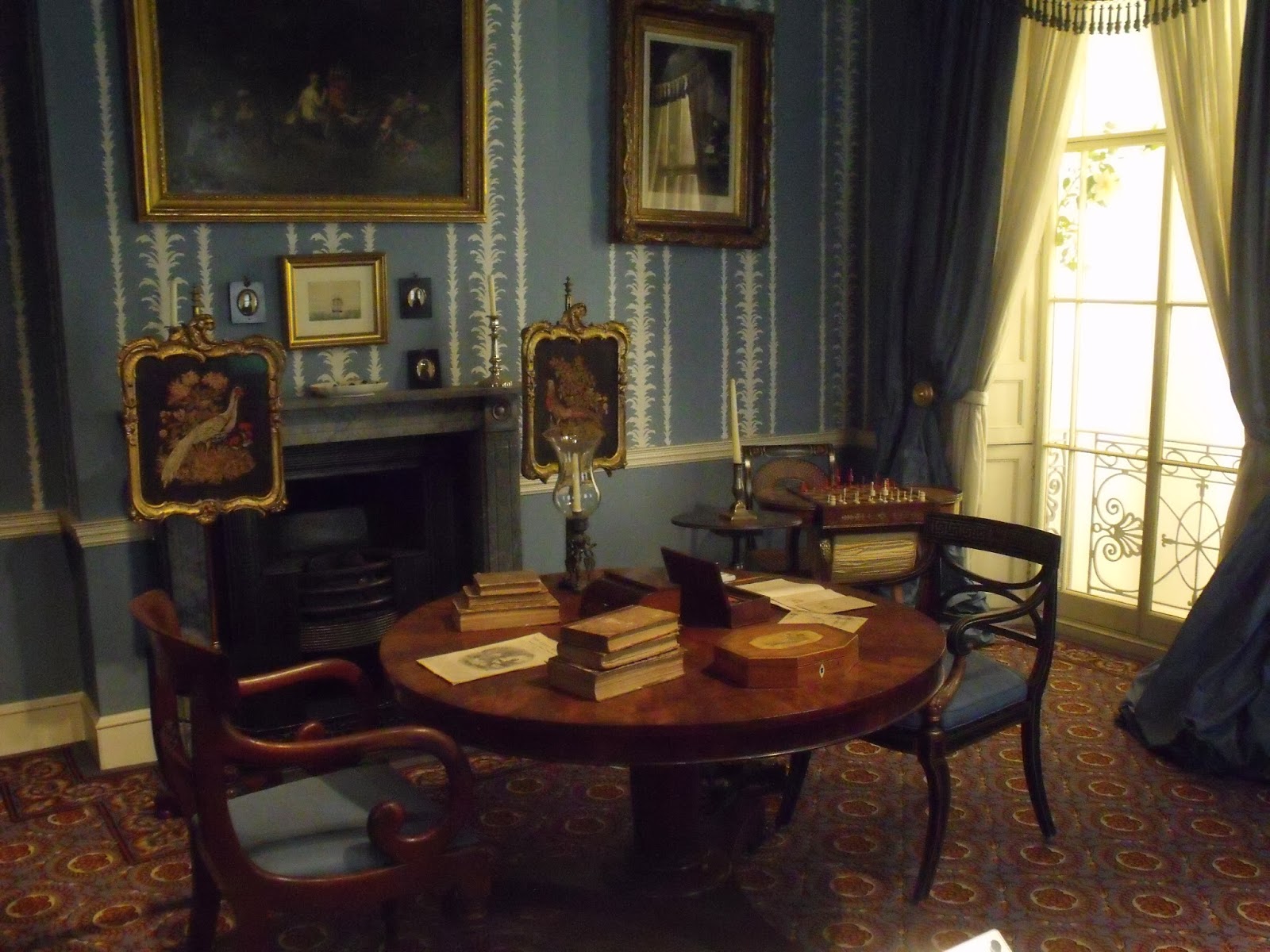
I looked closely at Victorian main reception rooms which are better known as the drawing room. I looked at drawing rooms in the Geffrye museum in 1830 and 1870; I did this, as Mary Barton was published in 1848. I found that the choice of patterns, colours and materials increased over the first half of the nineteenth century. In the drawing room for example it would have been wallpapered and have had fitted carpet. It is very clear from this, my visit to the museum and Mary Barton that drawing rooms were middle-class orientated. I was surprised to find out that t
he set out of the homes were very similar:

"On the right of the door, as you entered, was a longish window, with a broad ledge. On each side of this, hung blue-and-white-check curtains, which were now drawn, to shut in the friends met to enjoy" (Mary Barton, 14)

It is seen to be more private when the curtains are closed shutting the outside world out gives a sense of safety and protection which the drawing room gave to the middle-class. 


Drawing-room window from 1830 found in The Geffrye Museum


Susan Kyle Leopald notes, in The Victorian Parlour,  that the Victorian interior design portrayal of the  framed, draped windows (shown above) and the padded and upholstered chairs shown here: 

Armchair from 1870 found in The Geffrye Museum

"sea-sawed clumsily between homely comfort and happy grandeur" (The Victorian Parlour, 11)

This therefore can raise the argument of whether a middle-class Victorian family lived in a ‘house’ or a ‘home’. As it does not show the family orientated home like the one which the Bartons live in, in Gaskell’s novel. This was because the middle-class home was concerned with wealth and design rather than the 'homely comfort'. The armchair above has a red velour cover, this provides a 'feeling of luxury' which was associated to the middle-class. The description of the Carson house in Chapter 6, shows their house to be a design of their wealth:

"there was much taste shown, and many articles chosen for their beauty and elegance adorned his rooms" (Mary Barton, 63)

This proves that the design of the house had nothing to do with the individuals; it was just an act of their wealth. As well as this middle-class homes were full of art and did not look like they were properly lived in due to how they chose to decorate the room, stated above with 'elegance', and in the picture shown below that everything was immaculately furnished.Paintings in the Victorian period would have created a homely and luxurious vibe, and were commonly found in middle-class homes. The drawing room was a creative space where typically female members of the family would spend their leisure time reading, painting or playing music. This therefore shows how much a personal room the drawing room was.

Paintings in an 1830 drawing room
Sourced from the Geffrye Museum
It is seen to be a personal room in Mary Barton also. We can see this through Mr Carson's reaction when finding the superintendent in there as "his face hardened" (198). A reason why this could have been, is noted in The Victorian Parlour that the drawing room has:

"connotations of privacy, it is a space dedicated to the possibility of intimacy, set apart from the communal life of the monastery." (The Victorian Parlour, 13)

A Life Well Spent, 1862
Oil on canvas, by Charles West Cope
Found in the Geffrye Museum
This shows the importance a drawing-room to a family as it was a private place to be, whereas the other rooms of the house would have been full of servants. As well as this, it would have been a place where the children would have been, and it is evidently a place for women to go to read and be creative for example with needlework. The picture here shows a woman and her children, this illustrates solidarity and a mothers place in the household. It states in the Geffrye museum that, this young mother is depicted as the Victorian ideal as she is surrounded by her children and taking on the economical task of knitting socks. The young girl on the floor shows how girls were able to start education early and were able to enjoy reading in the home. The children here are well-behaved surrounding their mother and eager to learn. This was the expectation of young women at this time.

In comparison to the middle-class home discussed above, one passage which struck me about the Barton's home was the descriptions at their tea party. Their surroundings are warm, portraying a happy family. There are strong descriptions here, we see that their possessions were on show and that they were proud of who they were:

"Mrs Barton was proud of her crockery and glass, for she left her cupboard door open" (Mary Barton, 14)

Although the Barton's were not middle-class I found many similarities within the museum to the descriptions in Mary Barton. As well as the above possessions we also see that there are japanned goods:

"Opposite the fireplace was a table, which I should call a Pembroke. On it, resting against the wall, was a bright green japanned tea-tray(...) propped up by a crimson tea-caddy also of Japan ware" (Mary Barton, 15)

Japanning was a technique for decorating furniture and small objects in imitation of Japanese or Chinese lacquer. Japanning is mentioned above to describe the furniture of a typical tea party above. Japanning was developed during the seventeenth century and was cheaper opposed to lacquered goods which were a luxury and often found in middle-class homes. This is why this technique was often found in working-class homes.

A similarity which was visible from my visit and at the beginning of the novel was the overcrowded room at the tea party:

"The place seemed almost crammed with furniture (sure sign of good times among the mills)" (Mary Barton, 14)

It is clear from Gaskell's descriptions and my visit to the museum that the working-class home was a lot smaller than that of the middle-class. However, the cramming of the furniture was also visible in a middle-class home, this is a clear sign of how wealth had improved at the beginning of the 1800s.

Drawing-room from 1790 at the Geffrye Museum
Sourced from the Geffrye Museum
Drawing-room from 1830 at the Geffrye Museum
Sourced from the Geffrye Museum


This shows the sparsely furnished drawing room from 1790 compared to the 1830s where the room is even surrounded by all the decorative objects such as paintings and embroideries. 

Works Cited

Gaskell, E. Mary Barton.UK: Wordsworth Editions Limited, 2012.
Geffrye Museum. London, 1914. 29 October. 2013
http://www.geffrye-museum.org.uk/
Logan, T. The Victorian Parlour.  UK: Cambridge University Press, 2001.
Oxford English Dictionary. Oxford: Oxford University Press. 2013. oxforddictionaries.com. Web. 10 November. 2013


Saturday, 9 November 2013

Mr Whicher and the Road Hill House mystery

Road Hill House, front view
It is midnight on the 30th of June, 1860, and all is quiet in the Kent family’s elegant house in Road, Wiltshire. The nine family members (Mr and Mrs Kent and their seven children), the nursemaid and two servants are all sleeping or preparing to go to bed. It is peaceful, but when the nursemaid wakes up in the morning and discovers that Francis ‘Saville’ Kent, the four year old son, is not in his mother’s room the peace ends abruptly. A search for the boy is quickly arranged and it is Thomas Benger, a farmer, who finds the little boy’s body in the servants’ privy. The boy has been the victim of an unimaginably gruesome murder, with his throat cut so deep that his little head almost falls off. Even worse, the guilty is surely to be one of the remaining eleven persons who stayed in the house that night – the door was namely bolted from the inside. As Jack Whicher, the most celebrated detective of his day, arrives at Road to track down the killer, the murder provokes national hysteria at the thought of what might be festering behind the closed doors of respectable middle-class homes – scheming servants, rebellious children, insanity, jealousy, loneliness and loathing (The Suspicions of Mr Whicher).

I find the Road Hill House case to be very fascinating. Not only because both the case and Mr Whicher himself have inspired numbers of authors afterwards, or that they have, in a way, “laid the foundation” of how we picture the typical detective and detective story today. It is also fascinating and interesting because of the public hysteria it caused in the 1860s and years to come after it. Even now, there are still people who speculate about the true purpose of the murder and who truly was involved in it.
Mr Jonathan 'Jack' Whicher

The Road Hill House mystery is special in so many different ways, and one of the main reasons for this is because of Mr Jonathan ‘Jack’ Whicher. Mr Whicher was described as “the prince of detectives” by one of his colleagues and he was one of the founding members of the first detective force in the English-speaking world (The Guardian). He was assigned to the case when local policemen were unsuccessful to find the killer, and only days after he arrived at Road Hill House he had developed a brilliant solution to the mystery. He shocked society by accusing the 16-year-old Constance Kent, daughter of Samuel Kent and half-sister to the victim, for the murder of her younger brother. Mr Whicher based these accusations on a missing nightdress. In my opinion, you have to be quite clever to come to this conclusion based on so vague evidence, and still be utterly convinced by it [this will be discussed further on]. One of the reasons why this caused public hysteria was because a working class detective accused a young lady of superior breeding. Mr Whicher did not only cause a public arouse, but he was also attacked by the press and the House of Commons for his ‘horrifying allegations’ (The Guardian).

This difference in class was used as a sub-plot by Wilkie Collins in his detective novel ‘The Moonstone’ (1868). Collins’s novel is similar to the case in other ways as well. He fashioned from it a template for detective fiction, but instead of a child-murder and bloodstains, he wrote about a jewel theft and splashes of paint (The Guardian). Very much like the Road Hill House case, there is an investigator in The Moonstone who strives to expose the secrets of the inhabitants of an English country house, and his task is to distinguish the innocent from the guilty. Collins also borrowed some details from the Road Hill House ‘story’, such as a sullied and missing nightdress; a laundry book that proves its loss; an incompetent local police officer; and a renowned detective summoned to the countryside from London.

Another author who found inspiration in the Road Hill House case, and in Mr Whicher, is Mary Elizabeth Braddon and her novel ‘Lady Audley’s Secret’ (1862). The novel features some details which were present at Road Hill, such as a ‘wicked’ stepmother (a governess who married a gentleman), a brutal murder at an elegant country house, a body pushed into a well, and the fact that the novel’s characters are fascinated by detection and terrified of exposure. Mr Whicher is also “present” as the amateur detective Robert Audley.

Both ‘Lady Audley’s Secret’ and ‘The Moonstone’ were among the most famous of the “sensation” or “enigma” novels of the 1860s, and they were what Henry James called “those most mysterious of mysteries, the mysteries that are at our own doors… the terrors of the cheerful country house, or the busy London lodgings”. Their secrets were exotic, but their settings were oh so familiar.

The living arrangement in the Kent’s family during Samuel Kent’s first marriage is also very similar to the novel ‘Jane Eyre’. Samuel was living with his (supposed to be) derange wife and with an increasingly favoured governess, and this triangle has spectacular parallels with Charlotte Bronte’s novel (which by the way was published long before the murder at Road Hill House even happened). 

Constance Kent (in 1874)
It’s clear that the case has been quite the inspirational source for plenty of authors, but let’s put them aside for now and let us go back to the case instead. Because of the national hysteria, it is obvious that the case was in the newspapers. Many people speculated, of course, over who might have done it and though it was clear that someone from within must be guilty, it was still hard to grasp. The nurse, Elizabeth Gough, was first accused of the murder by the local superintendent John Foley, but the charges were dropped due to lack of evidence. Then when Mr Whicher took over the case, young Miss Constance Kent became the prime suspect (as previously mentioned). She denied that she had anything to do with the murder, and everybody turned against Mr Whicher and supported the Kent family instead. He still believed this hypothesis and he never gave it up. The case eventually closed, without officially finding the killer, and it is said that Mr Whicher said: “We will never know the truth until Miss Kent confesses”. And oh boy was he right… Five years after the murder of little Francis “Saville”, Constance walked into London’s Bow Street Magistrates Court, in the company of a priest, and confessed to the murder of her half-brother. She insisted that she acted “quite alone” and that it was not “out of jealousy”, but it is said that she later confessed to a friend that she did it out of hatred for her step-mother, ‘who had usurped her own mother, Mary Ann, in the Kent household’ (The Daily Mail). Mr Whicher also suspected that the brother, William Saville-Kent, was involved in the murder but no accusations were made. Constance Kent was convicted of the murder and sentenced to death by hanging, but was reprieved by Queen Victoria. She went on to spend 20 years in prison instead, before she was released in July 1885, at the age of 41. It was later known that Miss Kent sailed to Australia in 1886 – using the name Emily Kaye – where she worked as a nurse until her death in 1944.

So in the end, Mr Whicher’s suspicions about Miss Kent and the nightgown were proven true. I think it’s so impressive to come to the conclusion that she did it, based on a missing nightgown, the fact that she had been hiding clothes in that privy before and that she was physically strong (which is not much to go on). Based on the lack of evidence, one can understand why people thought that these accusations were very vague, so it’s amazing that Mr Whicher was right. He really is the true Sherlock Holmes, and it is sad that he did not get the acknowledgement he should have gotten while he was alive; that he is more famous now, after his death, for the inspiration he gave to the fictional detective, rather than the actual forensic skills he had as a detective. However, I am glad that people can still appreciate him now (even though they may not know it) through fiction, instead of leaving him and his brilliant mind behind - unknown - in the past.

If you want to know more about Road Hill House and Mr Whicher I can really recommend the book ‘The Suspicions of Mr Whicher’ by Kate Summerscale. It was released in 2008; it’s a number one bestseller and it has now been turned into a major ITV drama.

Bibliography
http://www.britishnewspaperarchive.co.uk/

http://www.dailymail.co.uk/news/article-1035832/The-whodunnit-How-murder-year-old-boy-gave-fictional-detectives-know-today.html

http://www.theguardian.com/books/2008/apr/05/featuresreviews.guardianreview29

Summerscale, Kate (2008) The Suspicions of Mr Whicher, London: Bloomsbury

Wednesday, 6 November 2013

Reframing the Victorians: Opera Singers in the Victorian Society

If I do say so myself, opera is amazing. As an opera singer in training, I greatly admire female opera singers of the 19th century. They were strong independent women who succeeded in a male dominated world, and gained respect in a society where they considered second class. They were successful, independent and wealthy, and not always married or reliant on men. However, their position in society was obscure as they had no position in the class system. These women were bestowed great honours by royalty, yet were not always fit to dwell with ‘high society’. In Downton Abbey, the character of Nellie Melba is excluded from dining with Lord and Lady Grantham as the butler thinks it inappropiate that she dine with aristocracy, yet sees it as below her to dine with servants.   The mysterious role of opera singers in society, to me, is a fascinating subject. 


Opera was established in the 17th century. It is important to remember that women had not long been performing on the stage; as far back as Ancient Greece, women were not allowed to perform on the stage, and this was a trend that carried through to the Elizabethan period. Opera was established as royal entertainment in Italy and France, they were flamboyant productions used to show off wealth and power for political visits. This shows that the role of opera in society has always been something quite elitist, as it still remains today. 

The Downfall of Shakespeare Represented on a Modern Stage. Dawes, William. 1763-65. London. V&A Online Archives. 


 Opera is seen as officially beginning in England began in 1636, when William Davenant secured a patent from King Charles I to build an Opera House. It was after this that it was prominent in England. In the 19th Century, one of the most successful Opera houses in London was the Royal Opera house in Covent Garden. The opera had moved away from being only a political expression of wealth, but was also a social expression. One star of the Royal Opera House I find intriguing is Nellie Melba. (Not only because the peach melba is named after her...)


Nellie Melba. Haviland, Frank. "Twenty Years a Diva: Mme. Melba's 20th Year at Covent Garden" Illustrated London News. June 1908.


Melba is a prominent and successful figure in opera. She exemplifies all the fascination of the Victoria Opera Singer. Born in Australia, she was the child of a builder, and was encouraged to study music from a young age, but was discouraged from having a career as a professional singer.
Like the steroetypical woman of her time, Nellie married and became a mother; she married Charles Nesbitt Frederick Armstrong in 1882. They had one child together, but the marriage did not last. Like women of her time, Nellie was abused by her husband and eventually left him.The fact that she had the confidence to leave her husband, and be an independent woman in Victorian society shows her determination; she would have been judged, and possibly even shunned. Nellie found herself in London where her debut was unsuccessful. It was then she was trained in Paris under Mathilde Marchesi, a prominent figure in opera. Her return to London after her training was still not received well; her performance in 1888 in Lucia di Lammermoor was not given a rave review. It was only with the support of Lady De Gray, who had influence at the Opera house, that she became successful. 

After numerous successful performances in London and in Europe, Nellie was at the height of her career, and was a successful independent woman. Had she become more than just a builders daughter? Or was she still just an opera singer? We can question her position in society by looking at her affair with Prince Phillip, Duke of Orleans. This created gossip and excitement, yet it was only an affair and would be nothing more. She was not suitable marriage material for someone of the aristocracy. This affair prompted Nellie’s estranged husband to file for divorce; a victorian taboo. It is hard to imagine that someone considered respectable in society would be adulterous. This part of Nellie’s life adds further speculation to how opera singers were considered. 

One interesting point about her life, is her role as Violetta in La Traviata, and how this could be a situation where life is imitating art. 


Punch Magazine. John Leech. 1857.


La Traviata by Verdi, makes an interesting comment about the ideas of women at the time, and in turn a comment on the reputation of opera singers. As an allegorical piece, it makes comments on the role of women and how they were expected to behave in the Victorian Era. The plot focuses around Violetta, a courtesan in 19th century Paris. She is a girl who is loved by many, and can be considered a socialite. It follows her story as she runs away with Alfredo, a man from a good family. His father disapproves of their relationship because of Violetta’s reputation and the fact that she is not seen as noble. This idea of her reputation is highlighted when Alfredo 'pays her for her services'.  This could be seen that like an opera singer, her role in society was nothing more than to entertain; going against the tight-laced and proper views of victorian women. 

This plot links back to the reputation of women at the time, and especially opera singers. The picture seen above is from Punch magazine, and can be used as an example of how opera singers were considered at the time. You can see the poster advertising La Traviata in the background, and the woman is clearly a singer, welcoming in another girl. The term ‘gay’ then being used as another word for prostitute. Were opera singers then considered the same social standing as prostitutes? Perhaps opera singers were, they were just entertainment in a different form. 
Crowquill, Alred. H Beard Print Collection (A scene from La Traviata) 1856. London - V&A Online Archives

This is only a glimpse into how opera singers were considered in Victorian society. Where did they fit in the social standing? They were fascinating women because of the power that they commanded, and they were able to be rich and independent without want of a husband. However, in Victorian society, this freedom would not have come without a reputation. They were women that were able to transcend the class system, yet still be part of an upper class world. Their role in this was limited because of the stigma attached to them. If we again look at Nellie Melba as iconic singer of the victorian era, the modern day adaptation of Nellie in Downton Abbey sums up how they were perceived in society. It is easy to argue that these women were not truly respected. They had immense talent, and as someone studying opera, I know how hard and taxing it is. Their voice was their life, and by having a voice, these women were iconic for their generation. 

Works Cited: 

The Early History of Opera - V&A Online Archives 

Opera in the 19th Century - V&A Online Archives 


Tuesday, 5 November 2013

Domesticity and Food in Victorian Culture

Domesticity and food is a common theme throughout all Victorian literature. It was the one aspect of Victorian culture that was central to the everyday lifestyle of many people. Here we will be looking at Mrs Beetons book of household management which at the time was a revolutionary piece of writing for women in the middle and higher classes. You will notice that I have not mentioned the lower and working classes. This is because the lower classes would usually be too busy working to be able to worry about running a household. What food they would have, would usually be simple and not something that you would be able to do a lot with.

Mrs Beeton’s Book of Household Management- morestylethancash.com

Barbara Megson writes in English Homes and Housekeeping 1700-1960 about how it was the industrial revolution that caused such a massive change in the domestic set up of Victorian Britain. She writes ‘The wife was left at home. Gradually her function became more and more idle and ornamental’. This gives us clear indication that life in Victorian Britain for a wealthy wife may not have been as glamorous as we imagine it to be and how popular TV serials depict these women’s lives. This is why when women like Isabella Beeton came along there was a huge surge in popularity for entertaining and throwing lavish meals. We get a very good example of this in Charles Dickens A Christmas Carol where when Scrooge is looking in on his nephews Christmas feast we are shown the wide array of fancy delicacies and expensive food that was there not only to be consumed but to show how wealthy the couple were.


Mrs Beetons Book of Household Management not only contained recipes but also tips on how to manage a property and servants. She even went as so far to include how much wages each servant each person should get depending on their role. She seemed generous as she says ‘If, also, a benevolent desire is shown to promote their comfort, at the same time then their respect will not be unmingled with affection and they will be still more solicitous to continue to deserve her favour’ (what a typically wordy Victorian sentence!). This then disrupts the notion that most people that were middle and higher class women were mean to their servants when in fact this was probably not the case at all. 
Typical Victorian servants- www.tigermoon.co.uk

For the poorer classes, food was something that was basically boiled down to you either had it or you didn’t. This is something that comes up commonly in Mary Barton by Elizabeth Gaskell. The book itself is widely accredited for showing how hard life in Victorian-post industrial revolution Britain was for the working and lower classes. A dissertation written by Pirjo Koivuvaara called Hunger, Consumption, and Identity in Elizabeth Gaskell’s Novels examines closely how food is a central role in Gaskell’s works.  At the tea party in chapter 2 of Mary Barton Gaskell writes ‘while it’s father, in an opposite arm-chair tried vainly to quieten the other with bread soaked in milk’ and she also says ‘cups and saucers made a noise, but human voices were still, for human beings were hungry and had no time to speak.’. Both these quotes give a clear indication that for the less well off, food was their one comfort when they had it and for them to flaunt it as the higher classes would do, was just not an option at all.

Moving on from the doom and gloom of class issues in Victorian Britain, let us discuss the actual recipes in Mrs Beeton’s book. The ingredients themselves to us seem rather disgusting but were in fact just common ingredients used by the Victorians. A particular favourite of mine is turtle soup. The first few things in the ingredients list are: ‘A turtle (I struggled to keep a straight face when I read how matter of fact this sounded), 6 slices of ham, 2 knuckles of veal…’. For people in the west, who are not used to eating turtle, this seems so odd and although it was a bit of a delicacy for Victorians, it’s just the fact that it’s in a recipe book that seems strange to us. Furthermore, another thing that may make you chuckle and leads on from the point about how matter of fact it sounds is when describing the ‘Mode.’  or method to us non Victorian folk. The first sentence reads ‘to make this soup with less difficulty, cut off the head of the turtle the preceeding day.’ I now apologise to any of the vegetarian readers out there. Of course eating turtle is still common in some cultures in the far east, so perhaps for them this wouldn’t seem so odd. 

Vietnamese turtle broth- internationallanguageprograms.blogspot.com

With the sudden interest is fine dining among the rich, the interest in how elaborate and fancy dishes could be made, also became rife. This is particularly noticed in jellies. Victorians are famous for their use of elaborate and decorative jelly moulds which would get fancier depending on how much money you had. However Mrs Beeton is quick to remind her readers that ‘Jellies are not the nourishing food they were at one time considered to be…’ . As the technology was not quite there during this period, it was hard for cooks to create gelatine that would produce a completely clear result. This is why a lot of the jellies we see are in fact cloudy or milk based. One of the more famous jelly based puddings to come out of the Victorian era, was of course the blancmange. This is probably one of the puddings that older readers will remember getting slapped onto their plate during school dinners. However, it’s probably not as bad as the recipe in Mrs Beeton’s book called ‘calf’s-feet jelly’. How awful does that sound!

 Traditional jelly style- www.historicfood.com

Although the rich are infamous for their grand feasts we must also take into consideration about how much work for the poor, most middle and higher class women did. Under the soup ‘Useful Soup for benevolent purposes’ there is a note by Nicola Humble which says ‘The above recipe was used in the winter of 1858 by the Editress, who made each week, in her copper, 8 or 9 gallons of this soup, for distribution amongst about a dozen families of the village’. So not only were the higher classes, keen to learn how to make succulent feasts on themselves, they were also sure to distribute amongst the poor. This may have been because at the time it was considered very important for a woman to be spiritually connected as this meant that she would be a pure and pious person. In fact this is something that is clearly seen in Jane Eyre by Charlotte Bronte. From the moment Mr Rochester, tries to get frisky with her she declines time and time again until she is actually married to him. Furthermore, in chapter 27 she says ‘God must have led me on’ when describing how lucky she was to get away from the immoral life she would have led, had she stayed with Rochester. This is all clear indication that suggests how domesticated women in Victorian Britain were expected to present themselves; as God fearing women.


Jane Eyre and Mr Rochester from the 2011 BBC adaptation- www.altfg.com

So, what we can basically conclude from this short introduction on the domesticity and food culture of Victorian Britain is that: the rich had it all, the poor had nothing(though rich ladies, did like to do their bit for charity), Victorians ate some strange food, and it was important to seem that you were a God fearing woman if you were to stand any chance of being accepted into society. Mrs Beeton’s Book of Household Management is a book definitely to be read by any Victorian enthusiasts out there as it gives a fantastic insight on just how day to day life in Victorian Britain was for the average wife.

Works cited
Beeton and Humble, N. 2000. Mrs Beeton's book of household management. New York: Oxford University Press.

Hughes, K. 2005. The short life & long times of Mrs. Beeton. London: Fourth Estate.

Brontë, C. and Minogue, S. 1999. Jane Eyre. London: Wordsworth Classics.

Megson, B. 1968. English homes and housekeeping, 1700-1960. London: Routledge & K. Paul

Gaskell, E. 1994. Mary Barton. London: Penguin.

Koivuvaara, P. 2013. Hunger, Consumption, and Identity in Elizabeth Gaskell’s Novels. [online] Available at: http://tampub.uta.fi/bitstream/handle/10024/66893/978-951-44-8780-4.pdf?sequence=1 [Accessed: 5 Nov 2013].

Sunday, 3 November 2013

Furnish your Victorian Life - Eccentricity


To equip, or to embellish, what role does furniture really fulfil? The Oxford English Dictionary defines ‘furnishing’ as the “action of fitting out or equipping,” whilst too defining such a process as an “action of decorating or embellishing.” The use of the words “equipping” and “embellishing” to define the act of ‘furnishing’ reflects a shift apparent in furniture as of the Victorian period as the eccentricity of the age meant houses were no longer merely “equipped,” but homes were rather “embellished.” As commented by Clive D. Edwards in his book Victorian Furniture, Technology and Design, as well as considering “comfort, cost, and suitability, consumers demanded other attributes from an object that would convey particular images and connotations to themselves and to others,” (4). I am going to explore such a shift in furniture from a means of 'equipping' to an end of 'embellishment' in the Victorian period.

Image sourced from the Victoria and Albert Museum, London 
This elaborate Indian table epitomises the eccentricity of the Victorians. Made in 1880, the high probability for its production being in response to an escalating demand for Middle Eastern furnishings within Europe reflects the shift from the ownership of furniture as a means of 'equipping' your abode to an end of 'embellishment.'  The meticulously designed patterns and octagonal shape displays how furniture was a manifestation of the people as the decorated pattern reflects the desire of the Victorians to laden their lives with ostentatious items. The octagonal shape of the table is striking as the unconventional design represents the shift in the purpose of furniture from a means to an end; as such a decision reflects a supply for an apparent demand based wholly on aesthetic desire. The Indian origin of this table is pivotal as such trade of furniture that could quite easily be created at home depicts the unconventional nature of the Victorians as the escalating desire for such an item reveals how far removed from tradition the Victorians really were.  This display of eccentricity can be seen in Elizabeth Gaskell’s unorthodox novel Mary Barton through the scrutiny of the Barton’s “table, which I should call a Pembroke, only that it was made of deal, and I cannot tell how far such a name may be applied to such humble material,” (15). It is clear that Gaskell’s use of the words “should” (15) alongside the idea of a “name” (15) to be “applied” (15) is a deliberate decision to depict the eccentricity of the Victorians as the need to comment on what “name” (15) “should” (15) or shouldn’t be “applied” (15) to the table is reflective of the Victorian desire to possess different and daring furniture in an attempt to portray a higher class.
 
Image sourced from the Victoria and Albert Museum, London
 
This image exhibits an oriental appearing tea set that expresses Victorian eccentricity at its most charmingly untraditional. The set was produced  from 1891 to 1894 and Victorian eccentricity lies in its foreign appearance which indicates the unconventional desires of the Victorians. Eccentricity is revealed in the fact that the creator of this tea set was in fact British. Christopher Dresser designed the tea service most likely with Japanese art in mind since he was the first designer from Europe to travel to the country in 1876. The way this art was made by a British man for a British Antiques store, Leuchars and Sons, evidences eccentricity as they were recreating foreign art in their own. The intricate ‘willow’ effect design of the tea set with the electric blue pattern set against a bright white background exhibits eccentricity as the bold colours reflects the bold movement in furniture from a means to an end. Victorian furniture as such a manifestation of irregularity can also be seen in Mary Barton in the description of the Barton’s home that outlines how “resting against the wall, was a bright green japanned tea tray,” 15. The use of the word “japanned” (15) here reflects this unconventional shift as the use of the past tense suggests a process that has been undertaken to achieve such an effect as opposed to the tea tray actually being of Japanese origin. This adoption of Japanese design is further explored in the notes to the text that explain that so called ‘Japanning’ is a process by which a piece is “varnished to imitate Japanese lacquer work,” (400). The word “imitate” (400) highlights the move from furniture as a means to an end as it was such an expression of the eccentricity of the people that it was even accessibleto and sought after by the working class.
Image sourced from the Victoria and Albert Museum
 
This elegantly painted tray demonstrates the eccentricity of the Victorians. Created in 1850, it expresses the extravagance of the Victorians in a similar way to the tea set seen above as the scene depicted on the piece “imitate(s)” (400) an oil painting, the original owner of which was the Duke of Devonshire. Eccentricity is seen through the inconsistent nature of the fact that focal to the tray is a painting that “imitates” (400) another, but such is bordered by gilt and mother of pearl. This tray was manufactured by Jennens and Bettridge whose work displays great Victorian eccentricity. In his book Victorian Furniture, Technology and Design, Clive D. Edwards comments that the reason for Jennens and Bettridge’s “fame rests on their use of unusual materials to decorate the blank shapes,” (128). This idea of filling “blank shapes” (128) demonstrates how this era was so eccentric the excess was even made accessible to the working classes. This can too be seen in Mary Barton within the description of the “bright green Japanned tea-tray, having a couple of scarlet lovers embracing in the middle [of it]. The firelight danced merrily on this, and ready (setting all taste but that of a child’s aside) it gave a richness of colouring to that side of the room,” (15). Displaying the accessibility of eccentricity is the idea of “all taste but that of a child’s [is] set aside,” (15) combined with the fact that the very same tray provided “a richness of colouring,” (15). The “richness” (15) supplied by the tray reveals the extravagance of even the working class in their wares, whilst the idea of it only appealing to the “taste (…) of a child,” (15) demonstrates how, as displayed in Jennens and Bettridge’s tray, this is nothing more than a mere working class Imitation.
Image sourced from the Victoria and Albert Museum

I also discovered this charming, floral dinner service at the Victoria and Albert Museum and it too reflects the quirky eccentricity of the Victorians. This set was made around 1820; the vibrant colours and exquisite patterns are quite clearly a reflection of excess and ostentatiousness, whilst the jagged edging of the included pieces is a move towards more modern design as opposed to emulating traditional ceramics, information sourced from the Victoria and Albert museum. Such indication of Victorian eccentricity is seen in Mary Barton as it is described how the Barton’s cupboard was “apparently full of plates and dishes, cups and saucers (…). However, it was it was evident Mrs Barton was proud of her crockery (…), for she left her cupboard door open, with a glance round of satisfaction and pleasure,” (14). The use of the idea that Mrs Barton leaves her cupboard door “open” (14) coupled with the contradicting word “however” (14) at the beginning of the sentence is clearly an indication of eccentricity within this Victorian family. The cupboard door is left “open” (14) for all to gaze at her “crockery” (14), but the use of the word “however” (14) at the beginning of this proclamation suggests that such crockery is rarely in use. This clearly exhibits the transition in the Victorian period from furniture as a means of “equipping” to a means of “embellishing” as eccentricity grew.
 
Through not only the trade but recreation of foreign art, the use of rare, ornate materials and the accessibility to such excessiveness within necessary domestic objects displays how Victorian furniture is a manifestation of the eccentricity of the people of the age. As declared by Edwards furniture and “furnishings are a classic case of the unspoken communication. They reflect the times and conditions that have made them, but at the same time express the aspirations and values of the owner,” (4). As Victorian furniture starkly expresses eccentricity it “reflect[s] the time,” (4) and acts indeed as an “unspoken communication” of the shift from furniture as a means to “equip” to and end of “embellishment.”   
Works cited
Edwards, Clive D., Victorian Furniture, Technology and Design. Manchester: Manchester University Press, 1993.
Gaskell, Elizabeth, Mary Barton. Hertfordshire: Wordsworth Editions Limited, 2012.
Oxford English Dictionary Oxford: Oxford University Press 2013. 3rd November 2013. http://www.oed.com/view/Entry/75684?redirectedFrom=furniture#eid 


Caring For The Sick: A Look At Victorian Medicine

The early Victorian medical practises were a world away from what we are used to seeing today. In the first half of Victoria’s reign, treatments didn’t evolve the way they were expected to. In the previous century, great advancements were foundational yet no progression was made during the early 1800s. This said, early Victorian physicians had some understanding of anatomy. However, their ideas of the nervous system and understanding of blood was a far-cry from what is understood today.

Due to this elementary understanding of how the body functions, medicine and diagnosis were rather primitive. This is greatly highlighted by the first understanding of cholera and its causes. Before the epidemic of 1845, cholera was thought to be caused by “rancid or putrid food, by ‘cold fruits’ such as cucumbers and melons, and by passionate fear or rage.” (Victoria and Albert museum).  As one can imagine, the ‘medicine’ for this included avoidance of the foods suspected of spreading the disease. Of course, through what we know today, this is undeniably ridiculous. However, their lack of biological and medical understanding made these causes believable.

Treatments for illnesses such as smallpox, scarlet fever and measles called for a “‘change of air’, together with emetic and laxative purgation and bleeding by cup or leech.” (Victoria and Albert museum). These methods ridded the body of ‘impurities’ thought to cause illness.

An enema pump used for emetic purgation

 Surgery was another place that the Victorians struggled on. In the early Victorian era, surgeries were performed with no anaesthetic. Although a skilled surgeon could amputate a broken leg in thirty seconds, often the blood loss and pain would kill the patient before the surgery was done. During these times, the mortality rate was, on average, one in four. As the Victorian era went on, pseudo-anaesthesia was introduced: alcohol and opiates, though these did little in the way of making the pain at least tolerable. Surgery was often a last resort due to not only the pain and suffering the patient would go through but also a surgeon would often have to deal with a patient squirming out of pain or fear; some also tried to escape. Therefore, surgery was only used if no other treatment was thought to work.

It is possible to witness the lack of medical understanding that was wrought in the 1800s through Gaskell’s writing in Mary Barton. In the novel, Gaskell highlights the primitive nature of medical care: “wild herbs for drinks and medicine” (30). This shows the rural traditions took over the urban setting and that anything a countryman could get his hands on would be used, in some way, for medical practises. Of course, this was harder in the city, thus they turned to purgation, a practise that had been in circulation for centuries. Gaskell also showed the Victorian mind-set of using reliable, or understood, medicines for many types of illness: “[…]it was typhus fever […] and proceeded to make up a bottle of medicine, sweet spirits of nitre […] very good for slight colds, but utterly powerless to stop, for an instant, the raging fever of the poor man it was intended to relieve.” (88) This, again, is due to what they had to hand but also the sheer lack of knowledge of the differences of dissimilar medical ailments.

However, during the later Victorian years, medical improvements were vast; the practises were more recognisable to what we are familiar with today. These developments and improvements included “the opthalmoscope (sic) and improved microscopes that revealed micro-organisms, to instruments like the kymograph, to measure blood pressure and muscular contraction. By mid-century, the stethoscope, invented in France in 1817 to aid diagnosis of respiratory and cardiac disorders, became the symbolic icon of the medical profession.” (Victoria and Albert museum)
 
Stethoscopes used in the 19th century


During the infamous cholera outbreak of 1854, thought to be caused by miasmas (the idea that ‘bad air’ from rotting fruits spreads diseases such as cholera, chlamydia and the Black Death), Dr John Snow established that the epidemic was caused by “contaminated water from a public pump in crowded Soho” (Victoria and Albert Museum). This made physicians more aware of bacteria and all the effects that cleanliness and sanitation had on the health of others. They began to understand more about the causes of illnesses and how to avoid them more appropriately.

Snow also paved the way for anaesthesia, being one of the first physicians to use chloroform and ether as a more effective way of putting patients ‘to sleep’ during surgery. In both 1953 and 1957, Snow used chloroform during the birth of Queen Victoria’s children.

Other surgical advancements that happened during the latter Victorian years included John Lister’s ideas around bacteria, infection and antiseptics. He realised that a “surgical wound infection was the result of bacteria” (science magazine) and thus tried to develop medicinal treatments that would eradicate this problem. However, his methods were constantly changing and began to grow confusing as he didn’t understand the problem completely. He began using varying dilutions of carbolic acid. “He also used vaporizing sprays that emitted an unpleasant and irritating acidic mist in the vicinity of patient and surgeon, but later denounced the use of this equipment.” (science magazine). However, by the 1880s, most surgery was antiseptic. This happened by surgeons making sure their hands were clean and later, they began using white overalls – similar to what we are used to seeing today – as a way of keeping their everyday clothes from contaminating the patients.

Much greater developments, in terms of cleanliness and sterilisation, occurred in the 1890s with dressings allowing surgical wounds to heal more effectively and healthily, as well as instruments that could be easily sterilised, replacing the bone and wooden handled tools that were not able to be sterilised quite so easily.

Bone-handled scalpels

With the understanding of bacteria, the diagnosis of a person’s illness became more reliable, as well as the treatment, especially surgery. The Victorian’s ideas of illness and medicine, that previously wasn’t dissimilar to that of the medieval era, began to progress quickly and efficiently. By the end of the Victorian era, medical practises paved the way for even more advancement during the 20th century.