Changes and Social Attitudes to Women’s Roles in the Victorian
Era.
 |
| Figure 1. |
Victorian
era was a period filled with changes which was to be expected considering that
it succeeded the enlightenment period. The enlightenment period presented an
opening for free thinkers to emerge and individuality to surface. Which thus
provided a platform for women who wanted to break free from the conventional
role they were expected to fulfil. The conventional role one that we, as
readers, are all too familiar with, the maternal passive female, who places her
husband’s needs before her own. This presentation of women is evident in many
literary texts throughout time, however within the Victorian era many
rebellious and unconventional women began to surface. Some of these fictional
characters making big waves through society and causing women to follow suit.
Rebellious protagonists resulting in rebellious women?
Fictional protagonists could be said to have inspired women to be
stronger and even stand up to be heard. Though it is clear that these
protagonists were purely fiction, these heroine protagonists effectively had an
effect on women in society. Resulting in great disputes and people discussing
the outcomes of these protagonists, which caused many to question what a
woman’s place in society really was. Henrik Ibsen’s A Doll’s House (1879),
is just one of the many texts that convey this rebellious character, who goes
as far as abandoning her husband and children. This alone would have caused the
contemporary audience to be greatly shocked at her actions as that alone would
be a reason to send her to an asylum. As a woman was not expected to be able to walk away from her children, or her husband, this would have been seen as an act of madness. As a woman's identity was based on motherhood, to be caring and the nurturer for the family rather than following her own desires. The iconic slamming of the
door, is one that caused a great outrage forcing Ibsen to create an alternate
ending. This only presents how a woman’s identity and her role was one that was
of great concern to the society. Many women in the late 1800’s began to rebel
against the conventional expectations of a woman, and began to present
characteristics of the ‘New Woman’.
The New Woman.
It was the New Woman that fuelled the fire of female emancipation
from the restrictions placed upon them by society. The Victorian fin de siècle
was the height of change, during this period the image of the New Woman had
emerged. Many texts began to convey the taboo subject of female sexual desires,
Thomas Hardy’s Jude the Obscure (1895) presents a couple – Jude and Sue, who cohabit and evidently have sex out of marriage. The stigma against a woman
who spoke of female emancipation, or even a woman who did not fulfil the conventions
expected of her was still evident within society. It is clear that
image was a very big part of the Victorian era, and that social norms were to
be followed and respected or you would essentially shut out from the community.
 |
| Figure 2: By Charles Dana Gibson. "Their First Quarrel" (1914) |
However, not all men were against women’s rights or the equality
of the sexes and not all women were for the cause. Beatrice Webb, for
instance signed the Ladies’ Appeal against the Women’s Suffrage. It was her
husband Sidney Webb, who was a strong supporter and ‘always claimed the credit
for making Beatrice change her mind’ (Caine, 168). Only conveying that not all
women embraced the concept of the New Woman. This could perhaps be due to women
being raised with concepts on what is expected and what is morally right as a
woman.
Good girls make great wives.
Women were raised to be great wives, from a young age taught how
to take care of a household. Many texts for young girls showing how a young
girl should behave and what she should essentially know. Parents usually bought
texts such as Maria Edgeworth’s well known short story “The Purple Jar”(1918) as it
had a set moral, a lesson the child would learn from. “The Purple Jar” in
particular was a text that conveyed to young girls how careful they have to be when they
essentially govern a household of their own. As the narrative is from a young
girl, Rosamund, making it easier for the young girl to relate to the short
story. In the text Edgeworth presents a direct consequence of Rosamund’s
actions by not examining the content of the jar with great detail and
essentially making the wrong decision. It is apparent that Rosamund learns her
lesson, one that will help her and many young girls in the future with taking
care of a household.
Women as property.
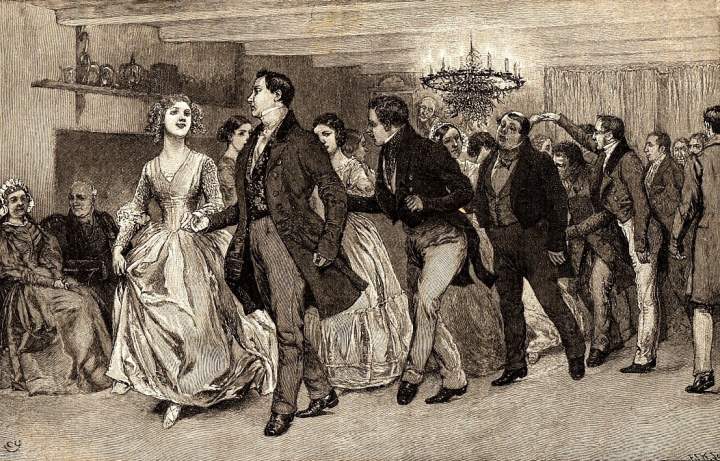 |
| Figure 3: By Charles Green. (1891) |
Women were often viewed as possessions, first a possession to the
father and then passed along to a husband who was then in charge of you as his
wife. Using Ibsen’s, A Doll’s House as an example Torvald, Nora’s husband, ‘No
one would believe how much it costs a man to keep such a little bird as you.’
(Act 1, page 6). The comparison between Nora and a bird only conveying this
notion of Nora stuck in a cage, restricted by the social expectations and her
husband’s restrains. Ibsen also presents the use of demeaning language through
the nicknames Torvald has for Nora, ‘little bird’ which was also very common
through literature.
To conclude, it is evident that throughout the Victorian Era
many women struggled with their identities and restrictions placed upon them
from a very young age. Evident from the types of literature read to young
girls, texts that teach them lessons that will aid further in household
management. Furthermore, women were constantly being reminded of their place in
society, the print of texts like Isabella Beeton’s The Book on Household
Management(1861). Beeton’s book full on how to successfully manage your household,
just from the first page it is evident that Beeton perceived the management of
a household to be of great importance. As she compares a mistress’s management
of her household to a commander with his army. However, it is still clear that
the expectation from society was for a woman to be an obedient daughter and
then a great wife for her husband. On the other hand, it is evident that a
woman’s role was constantly changing within the era thus resulting in the New
Woman image that many adopted.
Images used.
Figure 1: <http://www.victoriana.com/history/images/women-2.jpg>
Firgure 2: Charles Dana Gibson. "Their First Quarrel". 1914. <https://upload.wikimedia.org/wikipedia/commons/f/f9/Their_First_Quarrel,_Gibson.jpg>
Figure 3: Charles Green. "Among Those Who Danced Most Continually Were the Two Engaged Couples" (1891)
<https://www.google.co.uk/url?sa=i&rct=j&q=&esrc=s&source=images&cd=&cad=rja&uact=8&ved=0ahUKEwj4_vjbmMrLAhWMBZoKHW_rCSUQjRwIBw&url=https%3A%2F%2Fyorkvicsoc.wordpress.com%2F&bvm=bv.117218890,d.ZWU&psig=AFQjCNEtHUcRomOwu62wac6txPSFjhIlXw&ust=1458388479813439>
Work Cited/ Used.
Beeton, Isabella. The Book of Household Management.
Ex-classic projects. 2009. Web. 8th March 2016.
Buzwell, Greg. “Daughters of decadence: the New Woman
in the Victorian fin de siècle”. British Library. Web. 10 March 2016.
Caine, Barbara. Destined
to be wives The Sisters of Beatrice Webb. Oxford: Oxford University Press.
1989. Print.
Edgeworth, Maria.
Rosamond: A Series of Tales. “The Purple Jar”. London: George Routledge and
Sons Ltd. 1918.
Hardy, Thomas. Jude the Obscure. The Project Guttenburg. August 1994. Web.
Ibsen, Henrik. A
Doll’s House. Trans William Archer. Web. 6 March 2016.
<
http://www2.hf.uio.no/polyglotta/public/media/libraries/file/10/A%20Dolls%20House-%20Henrik%20Ibsen.pdf>
Parker, Julia. Women
and Welfare: ten Victorian women in public social service. London: The
Macmillan Press LTD. 1989. Print.
Picard, Liza. “The Victorian middle classes”. British
Library. Web. 10 March 2016. <http://www.bl.uk/victorian-britain/articles/the-victorian-middle-classes>
Rowbotham, Judith. Good
girls make good wives: Guidance for girls in Victorian fiction. London:
Blackwell publishing. 1989. Print.
Vicinus, Martha. A
Widening Sphere: Changing roles of Victorian women. USA: Methuen & Co.
Ltd. 1980. Print.
