Friday, 5 December 2014

Freedom in constriction: The corset as form of female liberation


Victorian Corset Advert, 1886

The Victorian corset was a garment which was pivotal in the reshaping of the role of women in the late 19th century.

The image above attempts to illustrate the ideas society wished to project through the use of corsetry. The figure in the centre is a young women staring at herself in her hand mirror looking rather pleased with the sight that greets her. The caption beneath the image on the left hand corner claims the corset to be an “improvement”, making the assumption that the corset has improved her as a person and her sense of self, indicated by the mirror in her hand which represents personal image. The picture in the right hand corner is captioned “how delightful to be admired by everyone,” suggesting the corset brought women attention that they would not normally be worthy of garnering without one, and, as the last image demonstrates it had the potential to fully improve their lives in all aspects and projected them into better and more ideal ways of living within a perfect, boxed in society, just as the advert fits the woman into its neat boxes. Whilst it is exactly adverts such as this one which plagued feminist and religious discourse in opposition to corsetry it, also holds multiple truths of how the corset came to be an emblem of the paradoxical nature of the Victorian era.

The advert is proof that the corset was an item of clothing that many women were reluctant to give up for personal reasons, which defied male expectations including; personal satisfaction in bodily image, vanity, sexual allure and a sense of importance and status, all of which came with corset wearing and I want to prove that there was much more to this garment than the obvious ruin it is perceived to have caused. I believe that there was a reason as to why it wasn't until the 20th century that the corset died out, and why, even after its demise, women still have an utter fixation towards the corset; that it wasn't solely an object of oppression, but, more often than not, it was object of female power and control.

"The Corset Testing"
The dual nature of the corset, being both vulgar and modest is exemplified in this engraving from 1788 ‘L’essai du corset’ from the British museum, which shows a high born lady being fitted into her corset. Her garments, wig and surroundings all give her an air of aristocracy and decorum which are only added to by the constrained and fastened image of her corseted waist. However, her exposed breasts, which fixate the cleric sitting opposite her, show that that corset eroticises, and, much to the horror of religious dress reformists, breaks down the barriers of religious decorum as it enthrals even the clergy. But the lady in question does not give any objection; she merely revels in the attention she receives showing that it is quite likely that tight-lacers enjoyed the eroticism of it the corset as it “enable[ed] the female body to be read as seductive,” (Summers 124-5) without the woman having to jeopardize her delicacy and sense of propriety.


This eroticism of the corset inevitably led to the fetish practice of tight-lacing. David Kunzel points out that, contrary to what dress reformist would have us believe, tight-lacing was only practised in private by a select few, which indicated that, rather than responding to social expectations of women, which dictated that tight-lacing was a “relapse into barbarism”(Kunzel 571), tight-lacers were in fact “responding to a personal and inner compulsion” (Kunzel 577) meaning it was a form of social defiance, allowing them to enjoy the rarely acknowledged freedom that the corset presented. The corset gave women the opportunity to permanently alter their bodies to suit their desire. This ability to make their own decisions, even with regards to their own body, was one of the very few decisions Victorian women were allowed to make. In an age where the big decisions were made by men and involved little to no female participation, the ability to mould and keep her body in the way she wanted it gave women a sense of independence which they would have happily suffered for.


In addition to this power over the self, the corset also gave women the power to play on gender stereotypes in order to manipulate situations. If a lady wanted to put a halt to an event she felt unnecessary, she could depend on her corset to constrict her lungs and cause her to swoon which brought the men in control to her rescue. Many popular novels emphasised the great “heaving of bosoms” (Roberts 558) which the corset caused which, though most likely caused by a shortness of breath due to a lack of sufficient lung capacity, was often read as sexual. Great literary heroines also took advantage of the fact that the corset made them physically weak most times and manipulated this fact by emphasising their tendency to faint during stressful situations and thus playing on their female delicacy and submissiveness in order to manipulate situations. Horace Walpole’s heroines of The castle of Otranto, Isabell, Hippolyta and Matilda faint or swoon constantly in order to avoid experiencing or confronting the violent events of the narrative such as Conrad’s and Theodore's death and to afford them protection by the male heroes.

Whilst this eroticism helped to form marriages into possibly higher classes, the corset also helped maintain the appearance of these class structures by signalling class status. Unlike the slacken jumps which were often worn by the lower-classes for their ability to allow for freedom of movement, the corset was rigid and boned, therefore impeding movement indicating that its wearer was above the realm of manual, menial labour. As this deduction came with the assumption that the wearer was of the aristocratic classes, the corset also came to be symbolic of the tightly bound respectable values of upper classes. Summers points out that the corset “denoted good breeding,”
(9) and the fact that summers points out that domestic servants in receipt of these garments were often scolded for attempting to dress above their stations,” (10) indicates the value women themselves placed on their status in society and that they would readily protect the garment which illustrated them to be better than others.

Modern tight-lacer: Dita Von Teese
There were many reasons both practical and political for, the opposition to the corset. It is true that the corset was oppressive, restrictive, unhealthy and at times vulgar. Yet despite what certain groups would have history believe the birth and survival of the corset was far not that straight forward because it was, and still is, a garment which women, not men, have, either consciously or subconsciously fought for.  Many items of clothing today from body shapers, waist cinchers, all the way to the introduction of liposuction surgery, all evolved from the corset and the female need to change her appearance to align itself with her possibly unattainable perception of beauty. Sites today, such as Contour Corset, are designed specifically to help women achieve the hourglass figure of their dreams by providing them with the very garments which our historical counterparts fought so hard against, culminating in the conclusion that it may never have been a case of women being slaves of society but of a their own minds demonstrating that “the women’s struggles getting in and out of corsets have not entirely ended” (Fields 379) and are unlikely to.


            Bibliography


Dorre, Gina Marlene. “Horses and Corsets: “Black Beauty,” Dress Reform, and the
Fashioning of the Victorian Woman”. Victorian Literature and Culture. Vol. 30. No. 1 (2002): pp. 157-78. E-journal. 09/10/2014 http://www.jstor.org/stable/25058580  

Fields, Jill. “ ‘Fighting the Corsetless evil’: Shaping Corsets and Culture, 1900-1930”. Journal
of Social History. Vol.33, No. 2 (1999): pp. 355-364. E-journal. 09/10/2014 http://www.jstor.org/stable/3789627

Kunzle, David. “Dress Reform as Antifeminisim: A Response to Helene E. Roberts’s “The
Exquisite Slave: The Role of Clothes in the Making of the Victorian Woman”. Signs. Vol. 2. No. 3 (1977). pp 570-579. E-journal. 09/10/2014 http://www.jstor.org/stable/3173266


Roberts, Helene. E. “The Exquisite Slave: The Role of Clothes in the making of the Victorian
Woman”. Signs, Vol 2. No. 3 (1977): pp. 554-569. E-journal. 09/10/2014 http://www.jstor.org/stable/3173265

Summers, Leigh. Bound To Please: A History of the Victorian Corset. Oxford: Berg, 2001.
Print

Walpole, Horace. The Castle of Otranto: A Gothic Story. Ed. Lewis.W.S Oxford: Oxford
University Press,20008. Print

Image sources


Image 1: http://staylace.com/gallery/gallery14/index.html

Image2:http://www.britishmuseum.org/research/collection_online/collection_object_detail
s.aspx?objectId=1440424&partId=1

Image 3: http://www.victoriana.com/corsets/Images/corset11.jpg

Image 4:  http://victorianparis.wordpress.com/2011/02/25/all-about-corsets-2/

Image 5:http://ayyyy.com/wordpress/wp-content/uploads/2013/05/Dita-von-Teese.jpg


Thursday, 4 December 2014

"Women in the Family Way" - Victorian Pregnancy and Childbirth

“Instead of wishing away nine months of pregnancy and complaining about the shadow over my feet, I’d have cherished every minute of it and realized that the wonderment growing inside me was to be my only chance in life to assist God in a miracle.” –Erma Bombeck

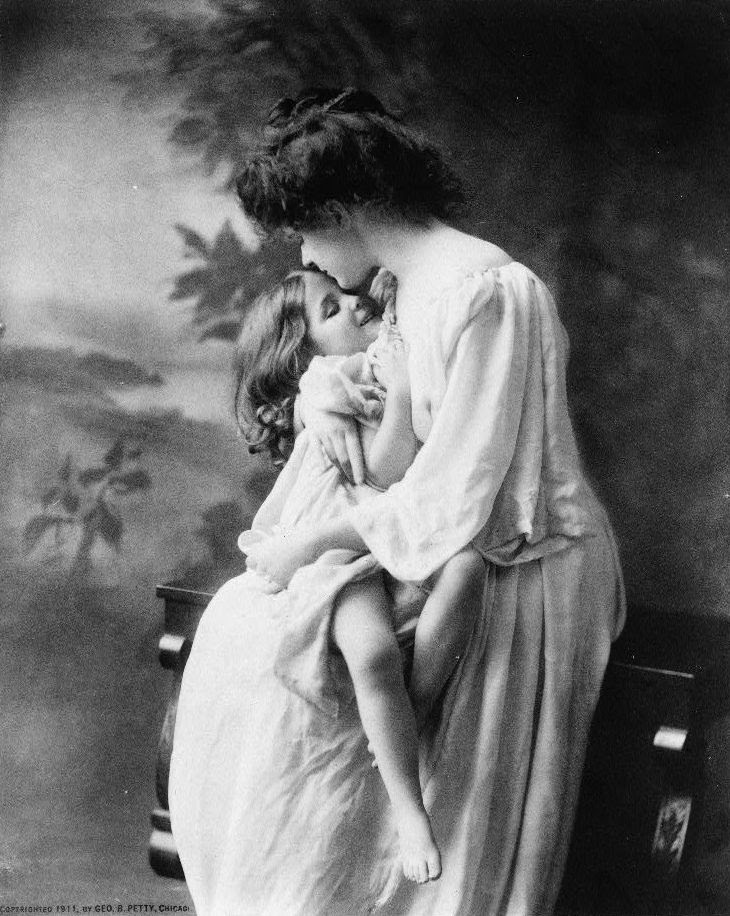
Figure 1: Victorian mother 


Giving birth to a child is arguably one of the most amazing and life-changing things a woman will do in her life – and also one of the hardest. If you think pregnancy and giving birth is difficult in the 21st century, imagine being a Victorian pregnant woman – wondering if either your pregnancy or your baby’s birth will kill you or not.

There is no doubt that Victorian medical practices, such as giving birth, were much more dangerous than they are now. The mere concept of hand washing while birthing a child did not come around until the 1840s. Not very surprisingly after the introduction of bathing your hands in a ‘solution of chlorinated lime before examining new mothers’ in 1842, childbirth mortality rates dramatically lowered from eighteen percent to about six percent.

One experience that all women who have given birth share is the indescribable pain that is experienced. Luckily nowadays we have various pain reliefs available, such as the epidural. This was not a luxury that women had in this period, at least until January 19, 1847 when either chloroform or ether was used as an anaesthetic to deliver a baby, even though it is now a suspected carcinogen. Even Queen Victoria used chloroform for her eighth birth in 1853. This use of anaesthetic became popular all over England - however it did receive some religious backlash. Many members of the British clergy argued ‘that this human intervention in the miracle of birth was sin against the will of God. If God had wished labour to be painless, he would have created it so.’

Figure 2: The birth of Princess Victoria


The normal method for administering chloroform to a patient would be to drop a dose of chloroform,
and place it on a cloth over the patient’s nose and mouth, so that it was to be inhaled. The fact that chloroform causes almost instant unconsciousness made it an extremely impractical method of anaesthetising the mother, and also risked the health of both mother and baby, even after labour. So to counteract this problem, Dr. John Snow (1813-1858) gave a smaller amount of chloroform to the patient (by only putting a few drops on a cloth). Similarly to modern pain relief such as the epidural, or a ‘spinal block’, this allowed the mother to feel no pain but still be able to push and be conscious enough to understand what the birth attendants are telling her to do – it worked as a numbing method.              

                                                                                                                 Figure 3: Chloroform being inhaled

Due to the fact that there was no such thing as ‘prenatal vitamins’, women were often anaemic while pregnant, and this created huge childbirth risks. Other risks to the mother’s health included having a retained placenta (when the placenta remains in the uterus after the baby is born – causing the mother to have to push it out separately), or the contaminated hands of the doctor, midwife and birth attendants.   

Childbirth was alarmingly dangerous in the 19th century, but pregnancy was just as life threatening. Creating a human being is hard enough anyway, but without adequate nourishment, all sorts of complications are created. Huge nutritional deficiencies such as vitamin D and calcium in the working class such as community during the Victorian era sometimes caused rickets, which led to a contracted pelvis and made birth more difficult.


One fashion statement that we often associate with the staunch and repressed Victorian woman is the corset – an outfit used to shape the waist and torso into an aesthetically pleasing shape – i.e. to give the woman an ‘hourglass figure’, exaggerating the bust and hips. A small waist was desirable for women because it suggested femininity, and therefore implied increased oestrogen production and higher chance of fertility. Due to the obvious physical restrictions that the corset placed on the woman’s lungs, torso and internal organs, the corset was so unhealthy for women that it would sometimes prevent pregnancy itself.


Figure 4: A Maternity Corset


The female body changes shape in the stomach area completely during pregnancy - one would think that a woman would be excused from wearing a corset for nine months – surely it would be impossible to fit a rounded abdomen into a tiny corset? Well it was apparently possible for Victorian women. There was no such thing as billowing shirts and dresses, and stretchy ‘maternity jeans’ in the Victorian era. Doctors and gynaecologists (who were interestingly all male) decided that if women still had to wear corsets during pregnancy, they should be expanded slightly in order to allow room for the growing belly. It was determined that between twenty and eighty lbs. of pressure per square inch on the female form. It would certainly be interesting to hear how 21st century women would feel about having to do this!


Figure 5 (above): Pregnant actress Lillie Langtry, 1852

Pregnant women were also confined during the last trimester of their pregnancy – so not only was their pregnancy confining physically, it was confining emotionally and mentally also, and must have been very lonely and consuming. The confinement period may be when women actually took their corsets off due to not being in the public eye.


Figure 6 (left): A heavily pregnant Victorian woman (Mid to late 1880s) 
                                          Figure 7 (right): Some modern day "maternity jeans"                                     


As we can see here, there is a big difference between the sort of clothing what Victorian women and modern women would wear while pregnant. It seems the woman on the left would experience a much more uncomfortable pregnancy: being restrained and restricted by her corset and the many layers of finery she is wearing. Women today are much more lucky - getting clothing tailored to fit their "baby bumps" - indicated here by the stretchy and more flexible material of the maternity jeans.


And finally, possibly the most ridiculous aspect of being a pregnant woman in the Victorian period was the prenatal advice they were given. It is said that pregnant women during the early 1900s were told that there was a link between prenatal nourishment and consumption and the temperament of the baby: one strange one being to avoid salty or sour foods such as pickles – because these type of foods might give the baby a ‘sour disposition’!


Bibliography

Boyle, Laura. "Developments in Childbirth in Regency and Victorian England" www.janeausten.co.uk. n.p., June 20, 2011. Web. www.janeausten.co.uk/developements-in-childbirth-in-regency-and-victorian-england/

McRobbie Rodriguez, Linda. "12 Terrible Pieces of Advice for Pregnant Women" www.mentalfloss.com. n.p., December 12, 2012. Web. http://mentalfloss.com/article/31877/12-terrible-pieces-advice-pregnant-women

Kodali, Shankar Bhavani . "Brief historical evolution of childbirth pain relief" www.painfreebirthing.com. n.p., n.d. Web. http://www.painfreebirthing.com/english/evolution.htm

Miss Cellania. "The Historical Horror of Childbirth"www.mentalfloss.com. n.p., May 9, 2013. Web. http://mentalfloss.com/article/50513/historical-horror-childbirth

Virag, Melissa. "Pregnancy, Survival and the Wasp Waist in the Belle Epoque" sucheternaldelight.wordpress.com.n.p., May 10, 2009. Web. http://sucheternaldelight.wordpress.com/2009/05/10/pregnancy-survival-and-the-wasp-waist-in-the-belle-epoque/4/

Wohl, Anthony. "Women and Victorian Public Health: Difficulties in Childbirth" www.victorianweb.org. n.p., n.d. Web. http://www.victorianweb.org/science/health/health6.html

Erma Bombeck quote: http://www.quotegarden.com/pregnancy.html


Picture Sources

Figure 1: http://www.tanglebright.com/uncategorized/happy-mothers-day/

Figure 2: http://historyandotherthoughts.blogspot.co.uk/2013/09/birth-of-victoria-princess-royal.html#.VIB6WzGsWRo

Figure 3: http://www.ph.ucla.edu/epi/snow/victoria.html

Figure 4: http://commons.wikimedia.org/wiki/File:Le_Corset_de_Toilette_-_61.png

Figure 5: https://emblah13.wordpress.com/2014/06/08/victorians-in-the-family-way-photographs-of-pregnant-ladies/comment-page-1/

Figure 6: https://emblah13.wordpress.com/2014/06/08/victorians-in-the-family-way-photographs-of-pregnant-ladies/comment-page-1/

Figure 7: http://www.queenbee.com.au/content.aspx?Dyn=true&pageID=66


Tuesday, 2 December 2014

The Victorian Seamstress

Imagine yourself in a poorly lit garret in Victorian England, working agonisingly long hours with no time for substantial food or even a chance to stretch your legs.  Your fingers are bleeding, your eyes are swollen and your ribs and spine endure on-going pain, day after day after day.  Your eyesight inevitably deteriorates as the many years go by, but you must tolerate this suffering in order to support your family on a deplorable wage.  This was the reality for many women during the Victorian era…


Seamstresses in Victorian Britain endured endless misery and pain through the exploitation of their occupation.  Young Victorian girls often entered this strenuous line of work to financially support their families.  This was often after their fathers had found themselves in hardship, leaving their daughters to provide the household income.  This is evident in Elizabeth Gaskell’s, Mary Barton.  Mary finds herself an apprenticeship with the dressmaker, Miss Simmonds, after her father had fallen into hard times.  Mary’s father was not too fond of this idea,

…he considered domestic servitude as a species of slavery; a pampering of artificial wants on the one side, a giving up of every right of leisure by day and quiet rest by night on the other
(Gaskell, 26).

Sources later discussed will support John Barton’s accurate thoughts on the lives of seamstresses.

The two most common fields of work in the nineteenth century for middle-class women were a governess and a seamstress.  However, not all women were able to reach the academic expectations to become a governess, so becoming a seamstress was the next respectable employment option for many middle class women.  It was much safer for young women to work as a seamstress in their own garrets, rather than walking to their employment.  However, though working in their own homes provided them better safety, they still endured agonising labour.  And though being a Seamstress was a respectable occupation for young women in Victorian society, it was still extremely punishing mentally, physically and emotionally. 

This exhausting work had young women living a life of pain and misery.  This distressing situation for many women of the nineteenth century became a strong influential concept in both art and in literature.

Figure 1. Richard Redgrave's 'The Sempstress'
Richard Redgrave’s ‘The Sempstress’ (Figure 1), is the first artistic portrayal of a seamstress I will be discussing.  This particular painting depicts the familiar image of an isolated and tiresome seamstress.  The notion of Victorian seamstresses dreary working and living conditions are shown through various aspects of this painting.  She is working through the night to the early hours of the morning (as indicated by the clock on the wall reading 2:30am).  Her eyes appear swollen, almost blind, which emphasises the intense repetitive physical labour Victorian seamstresses was forced to face.  The table beside her illustrates, almost unnoticeably, a small plate of food.  The minimal focus on this aspect reflects the attitude towards food that seamstresses were accustomed to.  It emphasises the level of labour they endured, as they had to work robotically through devastatingly long hours eating little to no food in order to utilise their time for clothes making. 


If you look closely out the window, we can see another lit garret in a neighbouring house.  This suggests that there are many more middle class women in other garrets in the same dismal situation.  The way the lighting falls onto the seamstress in Redgrave’s painting illustrates her as a saintly figure.  She is illuminated and is looking up, perhaps in the hope that God will save her from the circumstances that she has found herself in.  Another painting depicting the seamstress as a saintly figure is Anna Elizabeth Blunden’s ‘The Seamstress’ (Figure 2).  She looks as though she is praying to God.


Figure 2. Anna Elizabeth Blunden's,
'The Seamstress'

The horrors of the cruel experiences of the distressed seamstresses were unmasked through the 1843 publication of the Second Report of the Children’s Employment Commission, which shocked the Victorian public.  This report exposed the exploitation of the young women through numerous interviews and became a cause célèbre.  This report influenced many pieces of literature and poetry.  They depicted the monstrosity of the distressed seamstresses working conditions and welfare.  One of the most well known poetic demonstrations of the seamstresses’ nightmarish reality is Thomas Hood’s ‘The Song of the Shirt’, published in the 1843’s Christmas Issue of Punch magazine.

Through my first reading of this poem I felt that its clarity and unconcealed descriptions of the nature of seamstresses’ lives were hard-hitting.  This caused me to greatly sympathise with them, as it forced me to imagine the constant ordeals they experienced.   The semantic field of death was an important aspect to the poem, I felt that it strengthened and emphasised the exploitation of the seamstresses and the damage that their employment had on their health and mental state.  Here is an image of the poem taken from the popular magazine Punch, (if you enlarge this image and zoom in, you will be able to read the full poem)...

Punch Magazine - Thomas Hood's, 'The Song of the Shirt'


This poem tells the story of a young seamstress making clothes for men.  The tone of this poem expresses great sorrow and distress.  The semantic field of death clarifies the seamstress’s tribulation, one example of this is shown through the lines,

“It is not linen you’re wearing out,
But human creatures’ lives!”
(27-28).

This conveys quite a sinister image of the seamstress sewing her own body into the clothes that she is making.  This emphasises the idea of her dying from the consistent harsh labour she suffers.  It also shows the oblivious and inattentive attitude of those who wear the clothes made by the suffering seamstresses. 

This was an idea that was a popular topic in the mid-nineteenth century Punch magazine, as “many of the pieces in Punch are as concerned with awakening the customer to [their] responsibility as with revealing the conditions in which seamstresses worked and lived” (Alexander, 67).  Here are a few examples of illustrations depicting the relationship between the seamstress and the customer,


(Figure 3) depicts a customer vainly admiring her new gown, completely disregarding the exhausted and ghostly figure of the seamstress in the reflection of the mirror.  (Figure 4) relates to line 32 in Hood’s poem, “Sewing at once, with a double thread / A Shroud as well as a Shirt”, this idea is also depicted in (Figure 5), which emphasises the idea of seamstresses deaths arising from the exertion of their commodity. (Figure 6) presents the seamstress as a figure of death, as if her job has forced the life out of her.


Rose Dawson and her mother, Ruth
Dewitt Bukater in Titanic

This fear of one falling into hard times and finding oneself in the horrific situation of being a seamstress is also shown in the ‘corset scene’ from the famous 1997 blockbuster Titanic.  Rose’s mother fears that if her daughter fails to marry the wealthy Caledon Hockley, their family’s wealth and status will crumble.  This is Rose’s mother’s response to her daughter’s refusal to the marriage, “Do you want to see me working as a seamstress? Is that what you want?”  This reflects the possibility that women of a higher/middle class background were commonly at risk of finding themselves in the dismal situation of becoming a seamstress due to falling in harsh financial times.


Becoming a seamstress was a great fear for some young women in Victorian England.  But for the unlucky ones, it was their living nightmare...


Bibliography 


Gaskell, Elizabeth.  Mary Barton. United Kingdom: Penguin Classics, 2012. Print.

The Second Report of the Children’s Employment Commission (1843). Parliamentary Papers. Vol. 14.


Alexander, Lynn. Women, Work and Representation. Athens: Ohio University Press, 2003. Print.


Picture Sources


Figure 2 - Anna Elizabeth Blunden, ‘The Seamstress’ - http://www.victorianweb.org/painting/misc/blunden1.html

Figure 3 - (4 July 1863) “The Haunted Lady, or ‘The Ghost’ in the Looking-Glass,” John Tenniel, Punch 45 (p. 45)

Figure 4 - (19 August 1848) “’A Shroud as well as a Shirt.’” Punch 15 (p.76)

Figure 5- (23 July 1853) “A Startling Novelty in Shirts”, John Leech, Punch 25 (p.31)

Figure 6 - (October 1844) “Death and the Drawing Room, or the Young Dressmakers of England,” Kenny Meadows, The Illuminated Magazine 3 (p.97)