Sunday, 2 November 2014

Vicious Standards for Victorian Women

Lately there has been a recent widespread awareness and resurgence concerning feminism, “the social, political, and economic equality of the sexes,” (thank you, Emma Watson). In order to truly comprehend the positive affects that feminism has produced for contemporary men and women, and to see how far we’ve come in terms of woman’s autonomy, it’s imperative to look back on the standards imposed on women throughout history. During the Victorian period of 1837-1901, the standards for women were primarily related to domesticity. In this post, I’d like to briefly explore and (harshly and biasedly) critique the standards for middle-class Victorian women as I interpret them from my research on the subject and from an excerpt of a text that was produced during the Victorian period.


The essential function of the middle-class Victorian woman was managing the household, nurturing and instructing her children, and serving the needs of her husband. The picture this list evokes is one not too unfamiliar for us because these duties are akin to that of many modern day women who have families. Based on this description, the illustration of the Victorian woman simply sounds like a loving homemaker who selflessly tends to her family. However, the idea of this function was a bit more extreme than it appears. During the Victorian period, this train of thought was actually a dominant value system termed the “Cult of Domesticity” or “Cult of True Womanhood.” According to the system, femininity and “true” womanhood strictly resided in four virtues:

1)    Domesticity – A woman’s original habitat was the home—and the kitchen. Apart from taking care of the kids and the husband and making sandwiches, women were expected to undertake “feminine” activities such as sewing, cookery, making neat little beds, and gardening.
2)    Submission – Because men are superior to women by divine appointment, a woman could assert her true womanhood by being submissive to men. Take that!
3)    Purity – Unfortunately for Madonna, “like a virgin,” would not cut it in Victorian times. A woman was expected to retain her virginity until her wedding night.
4)    Piety – Religious beliefs were convenient because a woman could practice them in her original habitat and, according to the man’s interpretation, they encouraged the two values of submission and purity.

(As for physical attributes, “true” women were 
small, fragile, and weak—constricting corsets 
were a big hit for achieving this beauty standard.)

In addition to the term “true” woman, Victorian women who embodied these values were often referred to as an “angel in the house,” a phrase extracted from a popular Victorian poem by English poet Coventry Patmore.             

In Patmore’s narrative poem, The Angel in the House, which was first published in 1854 and developed until 1862, Patmore describes his idea of the ideal marriage based on his relationship with his first wife whom he considered to be the “perfect woman.” Book I, Canto IX, begins with the prelude titled “The Wife’s Tragedy,” which reads as follows:

1 Man must be pleased; but him to please
   2 Is woman’s pleasure; down the gulf
3 Of his condoled necessities
   4 She casts her best, she flings herself.
5 How often flings for nought, and yokes

   6 Her heart to an icicle or whim,
7 Whose each impatient word provokes
   8 Another, not from her, but him;
9 While she, too gentle even to force
   10 His penitence by kind replies,
11 Waits by, expecting his remorse,
   12 With pardon in her pitying eyes;
13 And if he once, by shame oppress’d,
   14 A comfortable word confers,
15 She leans and weeps against his breast,
   16 And seems to think the sin was hers;
17 And whilst his love has any life,
   18 Or any eye to see her charms,
19 At any time, she’s still his wife,
   20 Dearly devoted to his arms;                                            
21 She loves with love that cannot tire;                                  
   22 And when, ah woe, she loves alone,
23 Through passionate duty love springs higher,
   24 As grass grows taller round a stone.

This section of Patmore’s poem reveals the alarmingly submissive role that Victorian women played for their husbands, a role that the standard Victorian man and woman idealized. The first two lines of this poem states that woman’s happiness resides in her supplementation of her husband’s happiness. “Man must be pleased,” and it is the “woman’s pleasure” to please him. Since man’s happiness is presented as a circular cause and consequence of woman’s happiness, this statement begs the question of how a woman could find happiness without a man to please; the answer implies that the Victorian woman is reliant on man for her own pleasure. In lines 9-10, the woman is described as “gentle,” withholding “kind replies” to the man’s “impatient words” because she knows they might make him feel guilty. Instead of speaking, she remains silent and let’s her “pitying,” pardoning eyes do that talking (What they specifically say, I’m unsure. I think it’s probably something along the lines of, “Treat me however you want! If you’re happy, I’m happy!”). Despite the man’s impatience, the woman waits, expecting “remorse”—always expecting the best of her lover (11). When the man expresses shame for his wrongdoing, the woman is so deeply affected that she cries into his breast and feels guilty herself (13-16). 

This is the description of the ideal relationship between Victorian men and women written by a Victorian man himself. Evaluating this excerpt from a contemporary perspective, I’d describe the relationship portrayed not as a partnership, but a one-sided relationship where the woman is expected to make sacrifices that are not reciprocated. The focus of the poem is on the ideal Victorian woman, so it specifically elaborates on her continual choices to ease the pain of the man, but it never mentions the man having to do anything to receive such precious treatment. The man’s worth is portrayed as innate—he did not do anything to receive such treatment other than be born a man, which is the only thing we know about him from this excerpt. His worth is inherently recognized and supported by the woman, while the woman only seems to extract her worth from him and his pleasure. In this work, Patmore implicitly expresses the ingrained belief contemporary to the Victorian period that the ultimate purpose of women is to serve men, selflessly, and expecting nothing in return. I think it’s important to note that these standards were not solely imposed on women by men; most Victorian women imposed these standards on themselves (which is depicted in the woman’s submission in the poem). With the help of men and women who actually supported women’s rights and challenged the standards society subjected them to, the standards for women eventually began to change and they are continuing to progress today.

I hope I have provided a solid idea of the general standards that women were held to during the Victorian period. Contrasted with the beliefs, interactions, and opportunities of today, we have excelled measures in terms of equality and the establishment that women are of worth regardless of a man’s validation. With contemporary relationships between men and women being viewed as partnerships rather than domination-ships (like they were in the Victorian period), both men and women can experience an honest connection rather than one that’s strained as a result of the pressure to be a “true” woman.

Bibliography:

Boydston, Jeanne. PBS. PBS, n.d. Web. 30 Oct. 2014. <http://www.pbs.org/stantonanthony/resources/index.html?body=culthood.html>.

Patmore, Coventry. "The Wife's Tragedy." The Angel in the House Book I.--The Betrothal. Book II.--The Espousals. London: J.W. Parker and Son, 1858. N. pag. Print.

Welter, Barbara. "The Cult of True Womanhood: 1820-1860." American Quarterly. N.p.: John Hopkins UP, 1966. 152-74. Print.

Pictures from:

http://www.lingerie-stylist.com/style/agent-hourglass-the-world-of-waist-training/

http://angelsinthehouse.wordpress.com/page/2/

Thursday, 30 October 2014

The Corset and its consequences on women's behaviour and rights


The Corset and its consequences on women's behaviour and rights.


Women wore corsets because of the fashion but we can see that it is a part of their bond : the corset is a physical proof of women's compression. We can note that slavery was abolished in 1833 in the British Empire but in a certain way, the more the population was free the more the women pressed their corsets. Indeed, more than underwear, it became a part of their body without which they felt “naked”. The bond became a habit and men were paradoxically sometimes more alarmed by the consequences on their body than women themselves.


The fact is that the corset by itself is an interesting clothe and I experienced that feeling when I went to the Victoria and Albert museum. The first impression I had when I went to the fashion section was “What a beautiful dress” with sparkling eyes : the fabrics, the decorations, the cut, everything made women look like princesses and I think it is because of the corset which gives that shape to women. I noticed the same reactions from other people : “It must give so much inspiration for people who study fashion”, “Look at the corset!” and it made me wonder; why such a painful clothe could retain our attention that much? Even in the 21th century, while women's right changed, we are still attracted by the corset.


When I started to think about the corset I thought I could find a lot of stories about the pain and the consequences for women who wore corsets but the thing is that I didn't find so many testimonies and I found it even more interesting. Even Florence Nightingale, who wrote about women's conditions didn't say a word about the corset while she was really close to that subject in Cassandra. Here is a quotation which called out to me : “What form do the Chinese feet assume when denied their proper development?” I think we could ask the exact same question for the corset and women's waists but we can note that she choose to pick a example which doesn't belong to her country and habits. Yet she describes women's behaviour as a “farce of hypocrisy”, which complicates our present topic : women put themselves in that situation, and I found three different examples of the danger of wearing corset, seen by men or women.


“Hygiene of the corset”  in The morning postWednesday May 18, 1842, p. 6 by Gazette Medicale de Paris.


As I said, I found interesting the fact I couldn't find too many testimonies about women wearing corsets, and most of the time, men were writing about that subject in the newspaper more than women. From a scientific point of view, we can see how “evil” the corset could be : “One never would believe that women were capable of enduring such torture, if one did not actually witness it. How is it that a body so soft, tender, and with such delicate springs in appearance, can suffer so cruel and so constant a ligature!”.

The scientific who answers is making a great point when he writes : “it orders them to crush and to compress the chest, to prevent respiration, digestion, walking and running, and nobody opposes it.” because we can see how paradoxical it is to be fashioned if it's prevent you to live. He is also saying that women themselves did nothing to stop the phenomenon and it shows how much they were constrained in their actions. The corset made them weaker than they could have been.

“Melle Lucile, your daughter, is approaching an age when a wish to please is quite natural; but it is possible to please without an elancé shape, or, in other words, without the corset which forms and delineates it?” the scientific answers to a mother which is worrying about her daughter who might soon wear a corset, but in the answer he is actually denouncing the fact women think they need a corset to be attractive, and today I'm wondering why women had to do such things to pleased men and the corset is a good example of what the society commanded to them. It is all the more complex that women themselves thought it was compulsory and couldn't live without that article. He tries to convince the women of the natural beauty “Rest assured that the absence of a corset destroys neither the elegance of the shape, the fulness of its lines, nor the harmony of its movements – far from it.”  

“The Cholic” by George Cruikshank, 1819


This drawing was made in the early 19th century but the corset was already an important part of fashion and I would introduce this picture with a quotation from the precedent text which suit perfectly to the situation.

“for you may well conceive that the human body is not to be obstructed in its organs and functions with impunity. It is defying nature, who soon or late will be cruelly revenged.”

This picture makes me feel uncomfortable, and even if the corset is not drown we can understand it is represented by the animals which are pressing the woman. Her expression is frightening as much as the thinness of her waist. The unhealthy atmosphere which comes out of that picture should already have made some women aware of their own situation but the fact is that wearing a corset became a habit. It was such a part of their everyday life that sometimes they didn't even think it could be the cause of some illness, as the Marchioness of Simioni in the way she is described by Louise Lurine.

The New Corset – chap. I “The Corset Fitted”, in The World of Fashion, Wednesday December 1, 1841, p. 269, by Louise Lurine.


In this fiction, the author describes how the Marchioness of Simioni is forced to cancel her apparition to a masked ball because of a powerful headache. Let's compare two passages of the extract edited in the newspaper : the first from the beginning and the second from the end.

At the beginning, she is getting ready for the masked ball by her servant : “That happy corset was made of satin, broidered with gold, and the inventor of it boasted that it was made on a new system, which would at the same time give a new grace to the most beauteous figure, and even make an ugly waist look attractive. The corset, I am quite ready to admit, was a chef-d'oeuvre in its way ” we can see how beautiful the underwear seems to be, and it reminds me my reactions in the museum, but also a kind of irony which comes out the word “boasted”. The narrator doesn't believe that it could really work and the end of the days shows it : “But there was another grief to be endured by her, greater than all the rest ; for, as she advanced to a mirror to look at herself for the thousandth time that evening, it seemed to her as if, in the course of ten minutes, she had grown ten years older, and she thought herself ugly – abominably ugly”.


So, women don't need it to be pretty in that way and it is even unhealthy to wear corsets, but the social pressure and the fashion made the women wear corsets and be stick to it, as if they weren't allowed to live, despite of it's glamourous appearance, the corset was more a death instrument than a useful and effective accessory.  

What did the Victorians ever do for us? Education.

What did the Victorians ever do for us? They gave us good education.
A typical Victorian classroom
 In the 20th century, we are preoccupied with learning about the Victorians and throw ourselves into studying every inch of their existence. Whether it’s their clothes, their books, their food or their way of life we are adamant to understand it all, and we’ve become pretty good at it too. However, what we hear less about it what they themselves were learning about, rather than teaching us. Beneath their attitudes to working men and women, one finds themselves wondering whether teaching was seen as a respectable profession and whether children respected their teachers, as occurs now. With their caning, blackboards and traditional uniforms Victorian education is mostly laughed at in this day and age however, further research has led me to understand that more of our education is based on Victorian education than we may realise.

Schools in the Victorian era began being taken seriously for the first time in 1833 when the government awarded the first grants to schools to ensure quality of teaching was high, this however did not spark an influx of children in education as one might think. The reality of the matter was, that school was for the privileged children, and even then, rich children had governesses’ and poor children had jobs to do. There was no need for schools, and therefore, although schools existed they were not fully functional or beneficial to society. In 1844 parliament passed a law that stated the children who laboured in factories were to be given six half days off a week to attend school. However, this does not necessarily mean that children used or were allowed this time for studying as their employers and parents would prefer them to be earning money, as this was far more important in an era where financial security was almost unheard of. It was the Victorians who made the most drastic changes to education and the legislation surrounding it and therefore paved the way for new generations to enjoy the wonders of an educated society. In 1870, the government passed the first education act that dealt solely with the provision of education within the UK. This Act ensured that awareness of the importance of schools was understood within the community and showed the Victorians that the national issue of education had to be at the forefront of changes being made. The act “allowed voluntary schools to carry on unchanged, but established a system of 'school boards' to build and manage schools in areas where they were needed. The boards were locally elected bodies which drew their funding from the local rates. Unlike the voluntary schools, religious teaching in the board schools was to be 'non-denominational'.”

So imagine it’s 2014, and when you turn 6 or 7 and the realisation that you should be at school hits you. Upon asking your parents, they tell you that you are not allowed to enter the scholastic system because you are a female and this is considered inappropriate and downright unnecessary. As a female in higher education myself, this idea is incomprehensible. The right to an education is a right that should be imparted to all genders, of all backgrounds, in all cultures. In other words, EDUCATION FOR THE NATION. In the Victorian era, this idea was not necessarily agreed with and when schools began, girls were certainly not among the first to attend. However, Dame schools were present at this time which were developed in good faith but in the end only taught that this method of teaching children was mostly redundant. Dame schools were run by women, which was an issue in itself, but more to the point they did not have high standards of education whatsoever; Dame schools were short lived as they were abolished in 1880 for not reaching the government standards and were deemed inadequate.

When Dickens was writing his novel Hard Times, he was in the climax of the changes in education and the scholastic system. He made his thoughts clear on education, throughout his novel and begins it with Mr Gradgrind stating, “Now, what I want is facts. Teach these boys and girls nothing but facts. Facts alone are wanted in life” which highlights the vital need for schools. If schools did not teach these facts, these children would not be able to successfully “form the mind of reasoning animals” which, in turn, would leave the next generation at a loss. It is for this reason, that we must thank the Victorians and all their major changes to the school system. If it weren’t for them, we could possibly still expecting children at age 8 to be chimney sweeps and men to still be dominant in a demoralising way towards women. These children being taught “only facts”, as Dickens puts it, is what has led to some of the greatest thinkers the world has ever heard of. Those of us out there who have dreams of being teachers or leaders, this is what we have the Victorians to thank for. In Hard Times, Dickens contrasts educated people and non-educated by using the word “Hands” for labourers, but this only truly is understood by the reader when one of the “Hands” Stephen begins talking, and uses English dialect to emphasise to the reader the importance of education, and that there is a clear difference between his speech and everyone else’s: “Look how you considers of us, and writes of us, and talks to us, and goes up wi’ your deputations to secretaries o’ state ‘bout us, and how yo’ are alwus right, and how we are alwus wrong […]”. With this sharp contrast in speech, it is clear that the world Dickens envisaged without education was not sufficient for the future.

The Bethnal Green Museum is a branch of the Victoria & Albert museum in London which is based on knowledge of the Victorians and boasts elements of Victorian education that we take for granted, from items such as alphabet blocks to the well known abacus. As we all know, play is a crucial part of a child’s development and learning and it is for this reason that items such as these have such an important part in this museum. Using designs from Paul & Majorie Abbatt, Friedrick Froebel and Maria Montessori, the V&A allows a modern day researchers to understand how children were expected to learn through play in the Victorian era. On display, the museum currently has items such as the following:

This unwelcoming looking Jack in the box was manufactured c. 1820-1850 and was popular in the Victorian era for children’s development and play. The idea that the toy had basic science involved in the way it was a toy, was vital for children who had begun to grasp education.
© Victoria and Albert Museum, London.
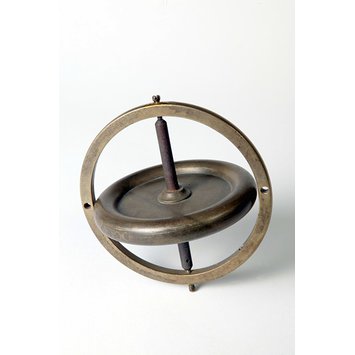
Here we see a Gyroscope which was manufactured c. 1860 in England. Toys like this, which were educational and fun, were very popular for children in the Victorian Era.
© Victoria and Albert Museum, London.

Throughout the Victorian era, the turnaround in terms of education was one of the drastic changes that created the world in which we live in today, but is not always remembered. Perhaps because we take education for granted these days, or maybe simply because we are too busy talking about the importance of gender and class divide that this is overlooked. It is important to remember that in this case, the Victorians saved us from years of uneducated generations and low paid jobs as a result of this. As a 19 year old undergraduate, I can safely say that the education reforms made all those years ago were most definitely worth it.

Works cited:
Dickens, Charles. Hard Times. London: Arcturus Classics, 15 Aug 2013. Print.
http://www.victorianschool.co.uk/schoolday.html

Gyroscope Image:
Jack in the Box image:

Tuesday, 20 May 2014

Jack the Ripper: Crime VS Prostitution.

In the late nineteenth century the streets of London were no stranger to crime, however petty it may now seem. The best depiction of such crimes is most deeply embedded through Charles Dickens’ Oliver Twist (1838) in Dickens’ representation of the lower-working class, and their way of survival. “‘Bill, Bill –’ grasped the girl, wrestling with the strength of mortal fear, ‘– I – I won’t scream, or cry – not once, – hear me – speak to me – tell me what I have done!’” (396); the way in which the character of Nancy, a prostitute, was so willing to degrade herself under the power of her lover, Sikes; is what influenced me to research into the topic of Jack the Ripper, and the strength of women in the late 1800's.

On the 26th of November I decided to embark on the ‘Jack the Ripper Walk Tour’ around the city of Whitechapel, and so we began with the inevitable questioning of who is ‘Jack the Ripper’? In Curtis’ novel: Jack the Ripper and the London Press (1894); “To play the game of ‘hunt the Ripper’ all one needs is a lively imagination” (27); in reading this concept, after going on the tour, the atmosphere of London of the cold November night and the enthusiasm of our tour guide truly brought the story to life. While standing on the former Buck’s Row (image left), where the first murder was taken place, we were warned of the harsh times of work in 1888 and the common filth that was London inhabited – both in a literal and metaphorical sense of the word. The 31st August, 1888, saw the first of Ripper’s murders: Mary Ann “Polly” Nichols, a prostitute; to which her throat had been slit, not once, but twice, from ear to ear, her abdomen had been stabbed and torn open, and she was left in the streets, killed and shamed, with her dress raised.

From the Frying Pan Pub (image right), and the now Sheraz Indian restaurant, that Nichols was reported leaving, to the stairs of Hanbury Street, the ambiance was still thick with idea that Jack the Ripper could have been watching these women from any street, any corner, even in plain sight. The second murder followed various themes of the first, in the way in which the woman was killed. Annie Chapman was found on the 8th September, 1888; lay across the steps of a home of number 29 Hanbury Street (see image left).
Alike Nichols, her throat has been slit twice, from ear to ear, but this time her abdomen was ripped out and her smaller intestines and placed over her shoulder. Her womb and the majority of her bladder and vagina had been removed, yet Curtis reports that “the mainstream morning press avoided any explicit allusion to sexual intercourse, and hardly any pelvic, not to say genital injuries ever appeared in the newsprint” (25). Now we have two prostitutes murdered in a week, both bodies to have been left exposed with their dresses raised, yet the possibility of a sexual encounter, in any form, was denied any publication.


On 25th September, 1888; what is known as the ‘Dear Boss Letter’ was received at the Central News agency, it read:
“Dear Boss,
I keep on hearing the police have caught me but they wont fix me just yet. I have laughed when they look so clever and talk about being on the right track. That joke about Leather Apron gave me real fits. I am down on whore and I shant quit ripping them till I do get buckled. Grand work the last job was. I gave the lady no time to squeal. How can they catch me now. I love my work and want to start again. You will soon hear of me with my funny little games. I saved some of the proper red stuff in a ginger beer bottle over the last job to write with but it went thick like glue and I cant use it. Red ink is fit enough I hope ha. ha. The next job I do I shall clip the ladys ears off and send to the police officers just for jolly wouldnt you. Keep this letter back till I do a bit more work, then give it out straight. My knife’s so nice and sharp I want to get to work right away if I get a chance. Good Luck.
Yours truly
Jack the Ripper
Dont mind me giving the trade name
PS Wasnt good enough to post this before I got all the red ink off my hands curse it No luck yet. They say I’m a doctor now. Ha ha.”

The letter received lead to the night of ‘The Double Event’, 30th September, 1888; where Elizabeth “Long Liz” Stride and Catherine Eddowes were taken as the third and fourth confirmed victims of Jack the Ripper. The body of Stride was found in the courtyard of Lewis Deimshutz’s property with her throat slit only once, still warm. Was Jack in the courtyard simply interrupted from his so called ‘job’? The mocking tone of ‘Jack the Ripper’ in the letter, combined with the two killings in one night, present the power of the murderer, the determination, and perhaps more importantly, the carelessness of prostitutes in the 1800's. The fourth murder of Eddowes, found in Mitre’s Square, (image above of tour guide in Mitre’s Square) had her face deformed and beaten in, her eyelids had been cut out and her ear had been removed. Mitre’s
Square now gives a beautiful view of the St Mary Axe (The Gherkin), but going on the tour, and seeing two rats run through the Square, the reality of London in the late 1800s, of the vermin and evil became a plausible thought.


On the 9th November 1888, the final of Jack the Ripper’s murders took place. Mary Jane Kelly was the worst of the five murders: the cutting of the neck remained, but her head was hanging my skin alone, the skin on her thighs, forehead, her nose and breasts were placed on a table; her hand inserted to her stomach. In Fishman’s East End 1888, he writes that “the ‘crime of being born female meant that women were at the bottom of the pecking order” (115). After the gruesome murder of Kelly, could it be reasoned that these five prostitutes were killed simply because they were women alone? Were they targeted? Were they merely ‘fallen women’? Take the Jack the Ripper tour and find conclude your own Jack the Ripper.


Works Cited:

Dickens, Charles. Oliver Twist. London: Penguin Classics: England, 1838. Print.

Curtis, L. Perry. Jack the Ripper and the London Press. Yale University Press, 1894.

Jack the Ripper’s Gruesome Tales. Web. 27. Nov. 2013.


Fishman, William. J. East End 1888. London: Duckworth and Co. Ltd, 1988.