Paralysis was studied in nineteenth century art, literature,
psychiatry, demonology, medicine, and (pseudo-)sociology. Having no definite
form, and eluding the empiricism of medical treatment, paralysis played on many
of the Victorians’ worst fears. As such, it occupied a prominent position in
the Gothic canon of the era, from the stories of Guy de Maupassant and Edgar
Allen Poe, to the paintings of Henry Fuseli. It was also a topic of ferocious
interest to the scientific community, with pathologists, alienists (an early
(and far better) name for psychiatrists), demonologists and physicians all
vying to prove that the root-cause could be explained through their discipline.
Two kinds of paralysis that horrified and fascinated both camps, were general
paralysis of the insane (GPI), and sleep paralysis. I’ll be tracking this
morbid strand through nineteenth century art, touching upon Maupassant’s death,
Nietzsche’s mental collapse, premature burial, and, of course, Fuseli’s horse.
 |
| Fuseli's horse |
GPI
General
paralysis of the insane is defined in the Dictionary of Nursing as “a stage of
tertiary syphilis characterized by dementia and spastic weakness of the limbs.”
However, this syphilitic link wasn’t accepted by Victorians until the 1880s:
prior to this, they considered it a “complication of insanity” (as if
insanity weren’t complicated enough). This assumption, and the name of the disorder, came as a result of the prevalence
of the condition in Victorian asylums. This table shows the severity of
GPI in 1859:
 |
| Statistics of deaths in asylums, 1859 |
As can be seen from the percentage of deaths from general paralysis, the mortality rate attributed to the condition was astronomical: as many as 4.65% of patients in asylums in England were dying from GPI. Considering that the highest number of deaths from all other causes was 12.2%, GPI was clearly the primary killer. To make the threat of this incurable, deadly, and elusive disorder even more terrifying to the artists of the era, there was a received wisdom in the nineteenth century that “brain workers” (people who use their brains for work rather than their hands) were more at risk from GPI than others. Studies such as this (below) from 1928, moved to disprove this theory through sociological research into those killed by GPI. As can be seen from the table, the percentage of observed “upper class” (presumably “brain worker”) deaths from the condition was actually lower than the percentage of observed deaths in “skilled workmen” and “unskilled workmen”. While studies like this made it apparent that theories about the increased susceptibility of “brain workers” were nonsense, this sort of research wasn’t carried out until the 1920s. On top of this, a cure wasn’t in sight until the discovery of penicillin in 1928 (which eventually wiped GPI out in developed countries) by which time the condition and the fear surrounding it had produced a profound effect on the arts.
 |
| Percentages of deaths by GPI through the classes |
 |
| Guy de Maupassant's death certificate |
The
spectre of death-by-paralysis haunted nineteenth-century literature. Guy de
Maupassant, the French short story writer, processed his fears over his
longstanding syphilitic symptoms through his work, which frequently featured
characters suffering with paralytic or cataleptic disorders. This is grimly
prophetic considering Maupassant's death certificate (pictured, left) lists his cause of death as GPI. He was syphilitic for
a great chunk
of his writing career, and experienced hallucinations, migraines, and fits of
paralysis. His short story “Who Knows”, written in 1890, 3 years before his
death, exhibits symptoms of GPI. Luis-Carlos Alvaro pointed this out in his
article on neurological conditions in Maupassant's work: “Maupassant’s
neurosyphilis (GPI) had advanced and its visual and mental symptoms were
clearly developed.”
 |
| Guy de Maupassant, and his moustache |
“Who Knows?” follows the mental collapse of its central
character on his return from a night out. He’s walking home when he begins to
hear a “humming noise”. The intensity of this experience steadily escalates
until he sees his armchair “waddling […] through [the] garden”. Alvaro
attributes these descriptions to Maupassant’s experience of migraines,
hallucinations, and “elaborate visual phenomena”, through his accelerating
neurosyphilis. GPI would go on to claim Maupassant’s life; but perhaps the more
threatening aspect of the condition for masters such as Maupassant, was its
capacity to turn the mind against itself.
 |
| Friedrich Nietzsche, and his moustache |
Another figure suffered an almost concurrent collapse under
GPI:
Friedrich Nietzsche (lower right), the German philosopher. Nietzsche, although
not considered so in his lifetime, was one of the premier thinkers of the
nineteenth century. A professor of philology by the age of 24, he crammed his
intellectual achievements into a very short career. Like Maupassant, Nietzsche
spent a good chunk of his life with syphilis (also, curiously, both had
magnificent moustaches). This is generally considered to have
developed into GPI, which took his sanity and eventually his life, although
this diagnosis has been challenged by more recent studies. Nietzsche was only
44 when he suffered his initial breakdown in 1889, after which his behaviour
was drastically altered: he spoke to himself and wrote bizarre letters, signing
them as “The Crucified One”. He was admitted to Basel mental asylum in January
1889, before being transferred to Jena, where his condition worsened. He had a
confused concept of his identity, and he repeatedly urinated and soiled
himself, usually proceeding to eat the faeces and drink the urine. He spent the
final years of his life in the care of his family, dying in 1900. Nietzsche’s
decline further demonstrates the fearful prospect that GPI represented to the
genius in the nineteenth century.
Sleep paralysis
 |
| Fuseli's The Nightmare |
Sleep paralysis was defined by Samuel Johnson in A Dictionary of the English Language (1755)
as “nightmare”. This definition is played with in the 1781 Henry Fuseli
painting The Nightmare (left). In the
piece, a demon sits astride a sprawled, unconscious maiden (and the eponymous
mare leers behind). This presents fairly accurately experiences of
sleep paralysis; one is accosted in a state of vulnerability by some assailant,
often demonic, who sits astride one, often throttling or otherwise assaulting
the victim. The horse may be peculiar to Fuseli.
Maupassant described a similar experience in his short story “The Horla”:
I sleep ... a long time ... then a dream ... no ... a nightmare lays hold on me. I feel that I am in bed and asleep ... and I feel also that somebody is coming close to me, is looking at me, touching me, is getting on to my bed, is kneeling on my chest, is taking my neck between his hands and squeezing it ... squeezing it with all his might in order to strangle me. I struggle, bound by that terrible powerlessness which paralyses us in our dreams; I try to cry out - but I cannot; I want to move - I cannot; I try, with the most violent efforts and out of breath, to turn over and throw off this being which is crushing and suffocating me - I cannot! And then suddenly I wake up.This is almost an exact reconstruction of Fuseli’s Nightmare (minus the mare). Alvaro interprets this dream as a manifestation of “anxiety bordering on a panic attack”. This both further characterises Maupassant’s experience of neurosyphilis, and points towards a more cultural sickness; the fear over the dormant self. The rise of “alienists” in the medical sphere prompted a growing awareness of the unconscious mind; and with awareness, came fear. What was this uncontrollable segment of the brain up to? Hence, this fear over sleep expressed a fear over the unconscious mind -- linked to another rising fear, over premature burial.
Premature burial
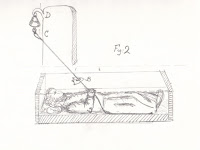 |
| A diagram showing the function |
 |
| An advertisement for a safety coffin |
The word for the fear of being buried alive is Taphophobia,
and in the nineteenth century, it was rampant. There was a thriving trade in safety coffins (left and right), which allowed the cadaver to
signal to those above ground that it wasn’t dead, if it should cease to be so.
There was also a Society for the Prevention of People Being Buried Alive,
founded 1896, and a Hospital for Doubtful Life, opened 1792, where corpses were
kept in warm surroundings until they began to rot. Just to make sure.
Edgar Allen Poe, seizing upon the widespread fear over live
burials, wrote a short horror story called “The Premature Burial” in 1844. In
this story, the narrator recounts a few horrific tales of premature burial,
before revealing that “for several years I have been subject to attacks of the
singular disorder which physicians have agreed to term catalepsy”. Catalepsy is
defined as “a condition of suspended animation”, in which the body can, for
months at a time, assume the appearances of death. The narrator fears that this
condition will lead to his premature burial: “I talked ‘of worms, of tombs, of
epitaphs’”. His fear, however, centres not around the fits of catalepsy that
seize him in his waking hours, but around sleep: “When the nature could endure
wakefulness no longer, it was with a struggle that I consented to sleep – for I
shuddered to reflect that, upon waking, I might find myself tenant of a grave.”
The narrator is not primarily fearful of the deception of his body, but of his
mind; and more specifically, his unconscious mind. The narrative proceeds, with the
narrator taking increasingly paranoid and drastic measures to pre-empt his
premature burial. Eventually, he experiences what he thinks is premature
interment, only to realise after minutes of panic that he is merely sleeping in
a cramped berth on a boat. The horror of thinking that he had been buried alive
causes him to embrace life anew: “I dismissed forever my charnel apprehension,
and with them vanished the cataleptic disorder, of which, perhaps, they had
been less the consequence than the cause.” This demonstrates neatly the
syndrome often expressed in sleep paralysis at the time: fear over the unconscious mind
led to frightening unconscious activity, and a cycle began.
What
GPI, sleep paralysis, and premature burial all prompted, was a fear of the
unknowable. Paralysis negated and resisted both literally and metaphorically
the ceaseless onward-motion of the nineteenth century, and thus occupied a
ghostly space in Victorian art, science, and minds.
Works Cited
Álvaro, Luis-Carlos. "Hallucinations and Pathological
Visual Perceptions in Maupassant's Fantastical Short Stories- A Neurological
Approach."Journal of the History of the Neurosciences 14.2 (2005): 100-15.MedicLatina
[EBSCO]. Web. 30 Oct. 2015.
Bondeson,
Jan. Buried Alive: The
Terrifying History of Our Most Primal Fear. New York: Norton, 2001. Print.
"catalepsy". Dictionary.com
Unabridged. Random House, Inc. 27 Nov. 2015. <Dictionary.comhttp://dictionary.reference.com/browse/catalepsy>.
Hurn, Juliet D. The History of General Paralysis of
the Insane in Britain, 1830 to 1950. Thesis. Thesis (Ph. D.), 1998. N.p.:
n.p., n.d. UCL Discovery.
Web. 30 Oct. 2015. <http://discovery.ucl.ac.uk/1349281/1/339949.pdf>.
Johnson, Samuel. "Nightmare." A Dictionary of the English
Language. 1755. Johnsonsdictionaryonline.com. Web. 28 Oct. 2015.
<http://johnsonsdictionaryonline.com/?page_id=7070&i=1363>.
Martin, Elizabeth A. "General Paralysis
of the Insane." Oxford Dictionary of Nursing. Ed. Tanya A. McFerran. Oxford: Oxford UP, 2014. Oxford Reference
Online [Oxford UP]. Web. 5 Nov.
2015.
Maupassant, Guy
De. Complete Short Stories of
Guy De Maupassant. Garden City, NY: Hanover House, 1955. Print.
Mckinlay, Peter L. "The Proportional Frequency of
General Paralysis of the Insane and Locomotor Ataxia in Different Social
Classes." Journal of
Hygiene J. Hyg. 27.02 (1928):
174-82. PubMed. Web. 27
Oct. 2015.
Orth, M., and M. R. Trimble. "Friedrich Nietzsche's
Mental Illness -- General Paralysis of the Insane vs. Frontotemporal
Dementia." Acta
Psychiatrica Scandinavica Acta Psychiatr Scand 114.6 (2006): 439-44. Academic Search Premier [EBSCO].
Web. 29 Oct. 2015.
Poe, Edgar Allan. Complete
Stories and Poems of Edgar Allan Poe. Garden City, NY: Doubleday, 1966.
Print.
"taphophobia". Dictionary.com's 21st Century Lexicon. Dictionary.com, LLC. 27 Nov.
2015. <Dictionary.comhttp://dictionary.reference.com/browse/taphophobia>.
Images Used
Brushfield, Mr. An image of Mr Brushfield's Statistics of
Asylums for 1859. Digital image. PB
Works. N.p., n.d. Web. 27 Oct. 2015.
<http://victoriancontexts.pbworks.com/w/page/12407425/Mr%20Brushfield%27s%20Statistics%20of%20Asylums%20for%201889>.
Fuseli, Henry. The
Nightmare. Digital image. TeachArt
Wiki. N.p., n.d. Web. 20 Oct. 2015.
<https://teachartwiki.wikispaces.com/The+Nightmare--Henry+Fuseli>.
Image of an
advertising flier for safety coffin. Digital image. Grave Matters. N.p., n.d. Web.
20 Nov. 2015. <http://www.marjoleinplatjee.com/2015/08/>.
Image of Guy de Maupassant's death certificate. Digital
image.Allposters.com. N.p., n.d. Web. 7 Nov. 2015.
<http://www.allposters.com/-sp/Death-Certificate-of-Guy-De-Maupassant-1850-93-7th-July-1893-Detail-Posters_i10073544_.htm>.
Image of sketch of
safety coffin operation. Digital image. Gothic.life.
N.p., n.d. Web. 21 Nov. 2015.
<http://gothic.life/why-victorians-had-bells-on-their-graves/image/1/>.
McKinlay, Peter L. Cropped image of table from journal
article. Digital image.NCBI. PMC, n.d. Web. 3 Nov. 2015.
<http://www.ncbi.nlm.nih.gov/pmc/articles/PMC2167761/?page=5>.
Unknown. Image
of 1883 photograph of Guy de Maupassant. Digital image.Exilio. N.p.,
n.d. Web. 4 Nov. 2015.
<http://exilioss.blogspot.co.uk/2012/02/guy-de-maupassant-18501893.html>.
Unknown. Image of photograph of Friedrich Nietzsche. Digital
image.Dasein.is. N.p., n.d. Web. 29 Oct. 2015.
<http://dasein.is/nietzsche/>.
Bibliography
Adler,
Shelley R. Sleep Paralysis:
Night-mares, Nocebos, and the Mind-body Connection. New Brunswick, NJ:
Rutgers UP, 2011. ProQuest
Ebrary. Jan. 2011. Web. 15 Oct.
2015.
Andrew
Roberts. "Mental Health History 1842-1844." Andrew Roberts' Web Site. N.p.,
n.d. Web. 27 Oct. 2015.
<http://studymore.org.uk/4_13_ta.htm>.
Frenzel,
Ivo, and Joachim Neugroschel. Friedrich
Nietzsche: An Illustrated Biography.
New York: Pegasus, 1967. Print.
Hide,
Louise. "Making Sense of Pain: Delusions, Syphilis, and Somatic Pain in
London County Council Asylums, C. 1900." Interdisciplinary Studies in
the Long Nineteenth Century 0.15
(2012): n. pag. Open Library
of Humanities. Web. 20 Oct. 2015.
Hirsch,
Harold L., and Lawrence E. Putnam. Penicillin.
New York: Medical Encyclopedia, 1958. Print.
Lerner,
Michael G. Maupassant. New York: G. Braziller, 1975. Print.
McDowall,
T. W. "Trephining Followed By Drainage
Of The Subarachnoid Space In General Paralysis Of The Insane." The British Medical Journal2
(1893): 462-63. JSTOR [JSTOR].
Web. 28 Oct. 2015.
Myrone,
Martin. Gothic Nightmares:
Fuseli, Blake and the Romantic Imagination. Ed. Christopher Frayling and Marina Warner. London: Tate,
2006. Print.
Wolf,
Peter. "Epilepsy and Catalepsy in Anglo-American Literature between
Romanticism and Realism: Tennyson, Poe, Eliot and
Collins." Journal of the
History of the Neurosciences 9.3
(2000): 286-93. Academic Search Premier [EBSCO]. Web. 27
Oct. 2015.
Further Reading
On GPI:
For an
overview, see: "General Paresis: MedlinePlus Medical Encyclopedia." U.S National Library of Medicine.
U.S. National Library of Medicine, n.d. Web. 2015.
<https://www.nlm.nih.gov/medlineplus/ency/article/000748.htm>.
For more
information on medical knowledge of the disorder in the context discussed in
this blog, see this from 1904: Kraepelin, Emil. Lectures on Clinical Psychiatry.
New York: Hafner Pub., 1968. Print. (See in particular lectures V, X, XII, and
XX for GPI).
For a
more detailed insight see from 1886: Mickle, William Julius. General Paralysis of the Insane.
London: Lewis, 1886. Print.
Or find
online at: Mickle, William Julius. "General Paralysis of the Insane." General Paralysis of the Insane.
Internet Archive, <https://archive.org/stream/generalparalysi00mickgoog#page/n14/mode/2up>.
On sleep paralysis:
For
analysis in literary/psychoanalytical contexts see: Schatz, Stephanie L.
"Between Freud and Coleridge: Contemporary Scholarship on Victorian
Literature and the Science of Dream-states." Literature Compass 12.2 (2015): 72-82. Academic Search Premier [EBSCO].
Web.
For studies of sleep
disorders/paralysis in Dickens, see: Greaney,
Michael. "Sleep and Sleep-watching in Dickens: The Case of Barnaby
Rudge." Studies in the
Novel 46.1 (2014): 1-19. Project MUSE [Johns Hopkins UP].
Web.
For a more modern, cultural study, see: Hinton, D. E. "Culture and Sleep Paralysis." Transcultural Psychiatry 42.1 (2005): 5-10. Sage Journals. Web.
On premature burial:
For an essay on Poe’s tale see: Forbes, Erin. "From Prison Cell to Slave Ship: Social
Death in 'The Premature Burial'" Poe
Studies 46.1 (2013): 32-59. Project MUSE [Johns Hopkins UP].
Web.
For analysis of the fear in general, see: Wojcicka, Natalia. "The
Living Dead: The Uncanny and Nineteenth-Century Moral Panic over Premature
Burial." Styles of
Communcation 2010.2 (2010):
176-87. Academic Search
Premier [EBSCO]. Web.
For Victorian literature that discusses
paralysis:
Burnett, Frances Hodgson. The Secret Garden. London:
Vintage, 2012. Print.
Collins,
Wilkie. Man and Wife. Ed.
Norman Page. London: Oxford UP, 1995. Print.
Corelli, Marie. The Sorrows of Satan, Or, The
Strange Experience of One Geoffrey Tempest, Millionaire: A Romance. Oxford:
Oxford UP, 1996. Print.
Craik,
Dinah Maria Mulock. John
Halifax, Gentleman: With an Introd. by Robin Denniston. Ed. Geoffrey
Whittam. London: Collins, 1954. Print.
Dickens,
Charles. Dombey and Son.
Ed. E. A. Horsman and Dennis Walder. Oxford: Oxford UP, 2008. Print.
Gaskell,
Elizabeth Cleghorn. Mary
Barton. Ed. Macdonald Daly. London: Penguin, 1996. Print.
My Lady Ludlow
from: Gaskell, Elizabeth Cleghorn. The Cranford Chronicles.
Lexington, KY: Seven Treasures Publications, 2010. Print.
Marryat, Florence. The Blood of the Vampire. Ed.
Greta Depledge. Brighton: Victorian
Secrets, 2010. Print.
Marsh,
Richard. The Beetle: A Mystery.
Ware: Wordsworth Editions, 2007. Print.
Find for free on Kindle: Maurier,
George du. The Martian.
eBook.
“The Adventures of the Resident Patient” from: Doyle, Arthur Conan. The Mysterious Adventures of
Sherlock Holmes. New York: Puffin, 1995. Print.
Find for free on Kindle:
Trollope, Anthony. The Belton
Estate. eBook.


